Asia Pacific Preparedness Hub
El Niño 2026–2027: Preparedness resources for Asia Pacific
El Niño is active and intensifying into a strong event, possibly a "super" El Niño. Compounded by global market disruption, the risks to Asia Pacific are significant. This page explains what that means, and brings together the resources National Societies need to prepare and act early.
Understanding El Niño 2026–27 risks
The El Niño–Southern Oscillation (ENSO) is the dominant driver of year-to-year climate variability worldwide. Originating in the tropical Pacific, it shifts rainfall and temperature patterns across Asia and the Pacific. El Niño is not a hazard in itself — it is a risk multiplier. It manifests through drought, floods, heatwaves, water shortages, food insecurity and livelihood disruption.
Declared active in June 2026, this El Niño event is very likely to be a strong one — potentially a "super" El Niño, on the scale of 1982–83, 1997–98 and 2015–16. Stronger events mean more intense and widespread impacts across the region. Every El Niño is different — past events are useful to learn from, but we should not assume the same outcomes.
El Niño follows a broadly predictable lifecycle: developing May–July, peaking November–January, decaying by March–May. That places the current event in its developing phase now, with peak impacts around the turn of the year and agricultural stress emerging from late 2026 into early 2027. The window for early action is open, and narrowing.
The Asia-Pacific climate is also shaped by the Indian Ocean Dipole (IOD), which peaks September–November. Because its peak overlaps ENSO's, the two can reinforce or offset one another. The IOD is currently neutral, but WMO and the Australian Bureau of Meteorology both flag an increased likelihood of positive conditions in the second half of 2026, which would deepen dry, hot conditions across Indonesia, Timor-Leste and the Maritime Continent.
Compounding risk
El Niño and Middle East crisis
Climate shocks are landing at the same time as fuel and fertilizer market disruption. Rising input costs, supply-chain fragility and procurement delays are diminishing coping capacity in parallel with drought and heat.
Impacts by sub-region
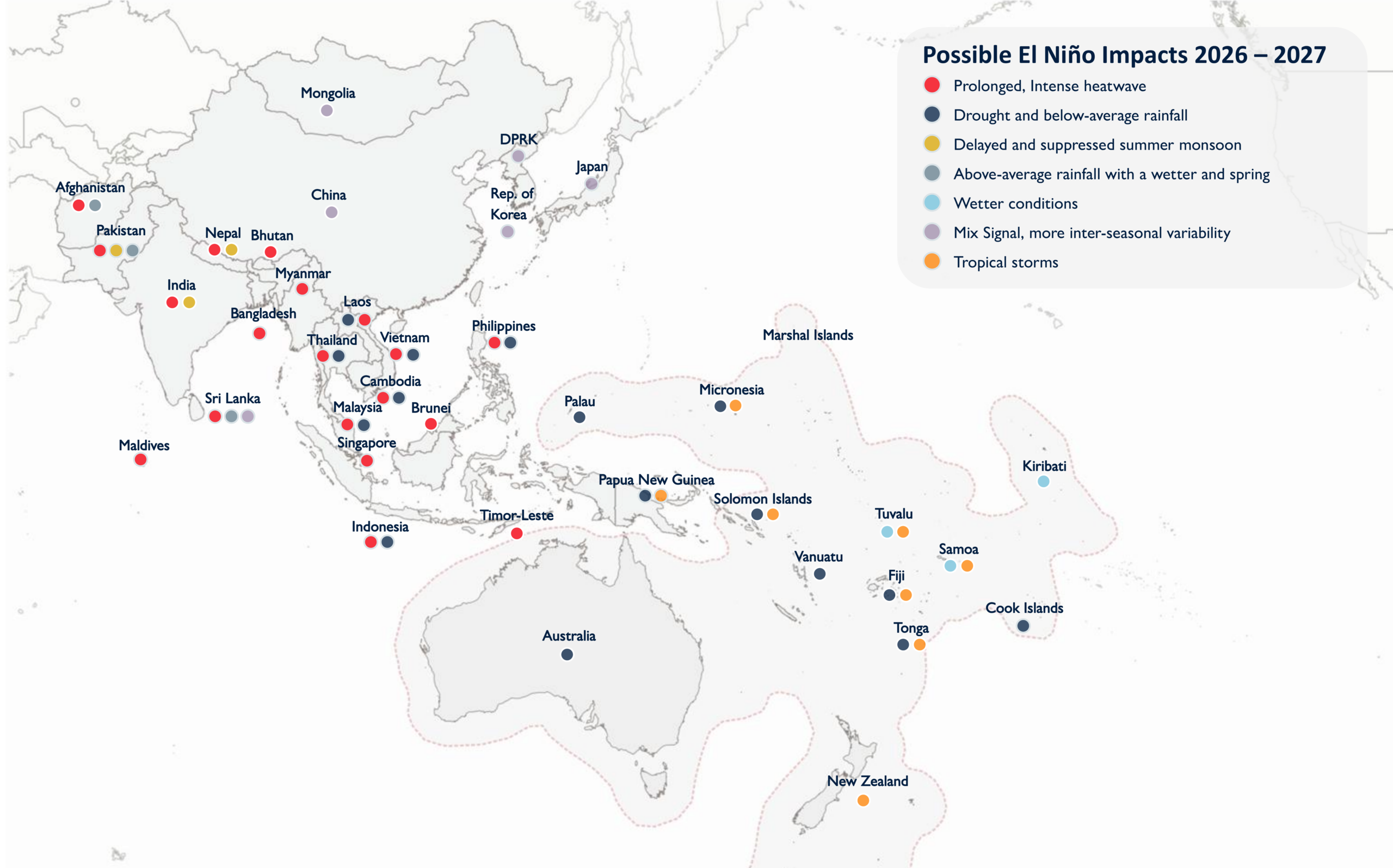
El Niño impacts across Asia and the Pacific vary considerably by sub-region, hazard type and timing — not every event unfolds the same way. The map shows the possible impacts by country; the panels below break them down by sub-region.
Impact map
Browse by sub-region
Select a sub-region to see which countries are affected and what to expect. Each tag is a possible impact — regions can face more than one.
Humanitarian Impact
- Below-average rainfall across much of the region
- Widespread above-normal temperatures and heat stress
- Increased frequency of extreme weather–related disasters
- Agricultural stress emerging from late 2026 into early 2027
- Increased risk of food insecurity and malnutrition
- Water scarcity and reduced access to safe water
- Displacement and protection risk in hazard-prone areas
- Health risks from heat stress and waterborne diseases
- Crop water stress at critical stages — planting, flowering, grain filling
- Potential yield reduction for rice, maize, root crops, vegetables
- Livestock, fisheries and aquaculture at risk
- Impact on rural livelihoods and food availability
Preparedness and early action
El Niño impacts build through the peak and land hardest in late 2026 and early 2027. That gives National Societies a critical window to prepare and act early, mitigating risks before they become emergencies.
Below are the key preparedness and readiness actions for National Societies, each linked to the guidance and resources for more information and recommendations.
Funding to act early
Anticipatory Pillar of the IFRC Disaster Response Emergency Fund (DREF)
RCRC National Societies can access Disaster Response Emergency Fund (IFRC-DREF) funding before a hazard strikes — not only after. The DREF offers four pathways: Anticipatory Action (forecast-based, triggered by agreed thresholds), Imminent (when danger is imminent), Response (immediately after impact), and Emergency Appeal scale-up (when needs exceed DREF capacity).
For slow-onset drought, use the Drought DREF operational parameter — it blends anticipation and response in a single operation, with early actions starting up to 6 months before the projected peak.
Resources
A curated set of information and operational resources to better understand and respond to El Nino impacts, selected by the IFRC Asia Pacific team.
Lessons from 2023–24 El Niño
The 2023–2024 El Niño was regarded as the fifth-most powerful ENSO event in recorded history. While there was no El Niño-specific operation or review, National Societies supported by IFRC responded through individual DREF and Emergency Appeal operations addressing hazards associated with the phenomenon. These are the lessons that recurred:
1
El Niño is a risk multiplier. Not a hazard itself — it manifests through drought, flood, heatwave, water shortage and food insecurity.
2
Access was the hardest challenge. Geographic isolation, security restrictions and logistical constraints repeatedly determined what could be delivered and how.
3
Local volunteers were critical. They maintained access, conducted assessments and supported distributions when external responders were constrained.
4
Flexibility mattered more than plans. Operations that adapted modality, timeline and delivery approach responded better to changing conditions.
5
Climate emergencies don't end with funding. A persistent gap remains between short-term response and longer-term resilience in water infrastructure, livelihoods and climate adaptation.

Developed and hosted by the Global Disaster Preparedness Center
Coming soon
This page is the first component of the Asia Pacific National Society Preparedness Hub, which will grow to include a full resource library, National Society capacity dashboard, news, events, training, and more.
© Global Disaster Preparedness Center · A joint initiative of the American Red Cross and the IFRC.