

Section 1: Commit to Action
Commit to Action
Implementing anticipatory action programming requires strong commitment and engagement from the National Society — ranging from leadership to technical teams. It is a collaborative process that involves coordination with key stakeholders, including national disaster management agencies and forecast/data-providing institutions.

Get Familiar With Anticipatory Action
In this section, your National Society will find an introduction to the concept of anticipatory action, along with the key policy and political commitments made by the Red Cross Red Crescent network in this area.
What is Anticipatory Action ?
Video: Anticipatory Action Explainer
Red Cross Red Crescent Anticipatory Action Policy
Anticipatory Action Within the Disaster Risk Management Continuum
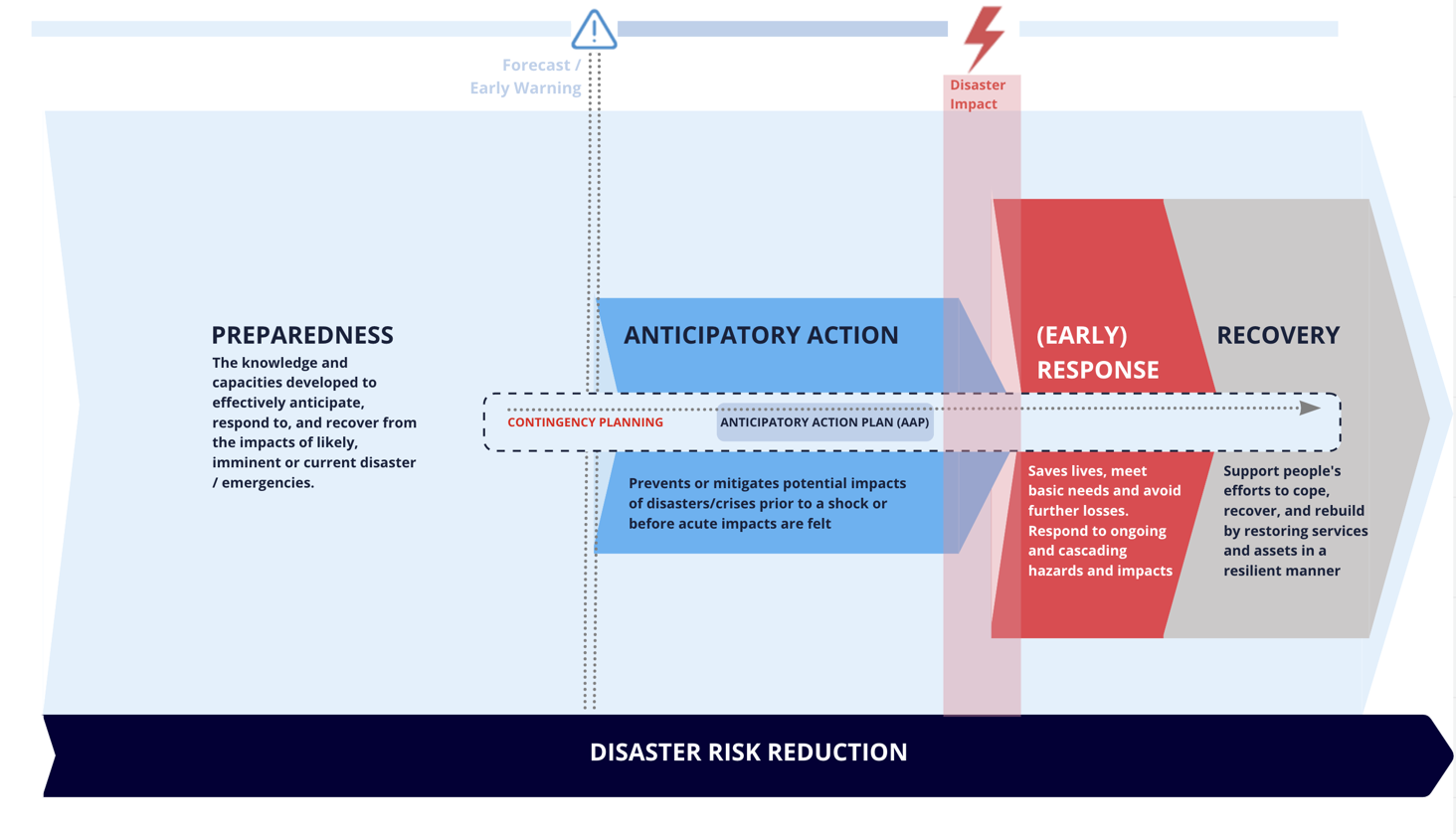
Anticipatory action bridges the gap between preparedness and long-term risk reduction and response and recovery. Triggered by a forecast or early warning — before a hazard becomes a disaster — it draws on contingency planning and a pre-agreed Anticipatory Action Plan to prevent or reduce impacts, complementing early response and recovery within the wider goal of disaster risk management.
Source: IFRC & German Red Cross, Forecast-based Financing Practitioners ManualLaw and Disaster Preparedness and Response
Engage Stakeholders
In this section, your National Society will find examples of stakeholders that need to be engaged across anticipatory action programming, best practices and practical stakeholder mapping tools that can be used to do the stakeholder engagement effectively.