Bangladesh

Past disaster eventsEM-DAT listing of disaster events in BangladeshDisaster statistics from UN-ISDR and CREDRisk country profile from Index for Risk ManagementDisaster response and management data from ReliefWebGovernment policiesHFA Progress Reports, government plans, and government statements and Poverty Reduction Strategy Paper – http://www.unisdr.org/partners/countries/bgdRed Cross + civil societyIFRC appeals and info bulletins for Bangladesh

Fortalecimiento de los Sistemas de Alerta Temprana para Todos: Evidencia y Lecciones de las Comunidades de Última Milla

Las alertas tempranas salvan vidas, pero solo cuando llegan a tiempo, son confiables y conducen a la acción. Este informe reúne evidencia de 15 estudios en 14 países para analizar por qué los sistemas de alerta temprana (SAT) a menudo no logran traducir las alertas en medidas de protección para las comunidades de última milla

Fortalecimiento de los Sistemas de Alerta Temprana para Todos: Evidencia y Lecciones de las Comunidades de Última Milla Read More »

A silhouetted community volunteer uses a megaphone to deliver an early warning message outdoors, with sunlight behind them against a clear sky.

Strengthening Early Warning Systems for All: Evidence and Lessons from Last-Mile Communities

This report synthesizes findings from 15 GDPC-supported studies across 14 countries to examine why early warnings often fail to translate into timely, protective action — particularly for last-mile communities that are geographically isolated, socially marginalized, or economically vulnerable. Drawing on empirical research and complementary literature, the report highlights that early warning effectiveness is shaped not

Strengthening Early Warning Systems for All: Evidence and Lessons from Last-Mile Communities Read More »

Forced to Flee in a Changing Climate: How IFRC is addressing climate and disaster displacement in Asia Pacific

This IFRC report highlights how climate change and disasters are driving displacement across Asia Pacific, the world’s most disaster-prone region. In 2024 alone, over 24 million people were displaced by disasters, accounting for more than half of the global total. Through 39 case studies from 21 National Societies, the report showcases locally led Red Cross

Forced to Flee in a Changing Climate: How IFRC is addressing climate and disaster displacement in Asia Pacific Read More »

Localized early warning voice messages – Solutions brief

Based on Climate Resilience Measurement for Communities (CRMC) data and community input, Practical Action identified a need for flood early warning messages to reach the most vulnerable in Faridpur District, Bangladesh. Using information from the national forecast, Practical Action develops understandable and actionable voice messages and sends them to registered mobile phone numbers to warn

Localized early warning voice messages – Solutions brief Read More »

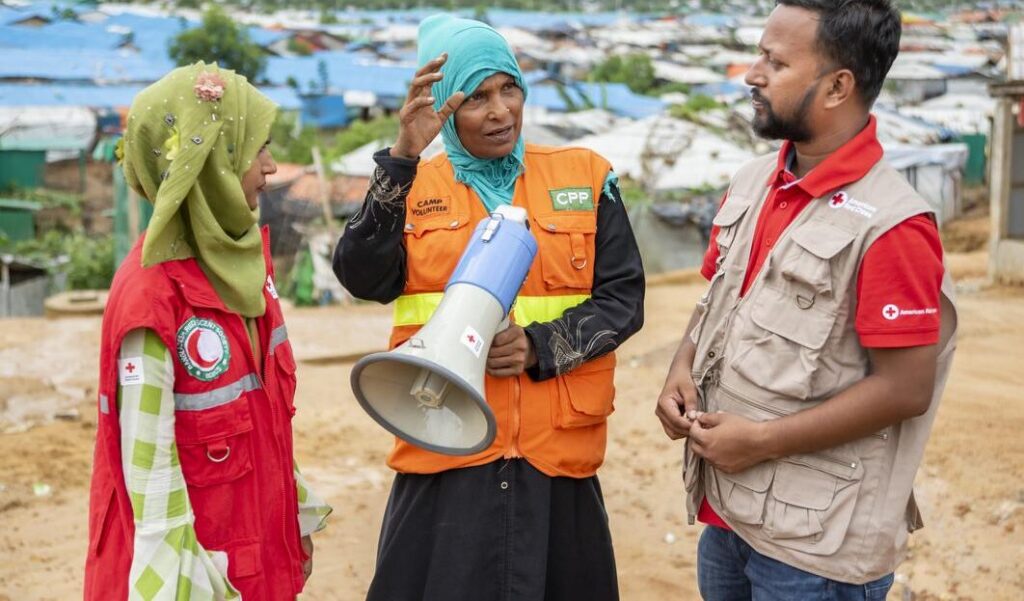
Red Cross volunteers train migrants in Bangladesh on first aid, early warning systems, and other skills so they can respond to flooding, cyclones, and other hazards.

Pre-Financing Anticipatory Action: Lessons Learned from the Bangladesh Red Crescent Society

Since 2015, the Bangladesh Red Crescent Society (BDRCS) has been at the forefront of anticipatory action, developing trigger models and testing early action activities for cyclones, floods, and heatwaves. By 2024, BDRCS had validated three Early Action Protocols (EAPs), targeting over 200,000 people, with an estimated activation cost of 940,000 CHF. Between 2019 and 2024,

Pre-Financing Anticipatory Action: Lessons Learned from the Bangladesh Red Crescent Society Read More »

Understanding evacuation behavior during cyclones: Evidence from Bangladesh

This paper examines evacuation behaviors in response to approaching cyclones using survey data collected through face-to-face interviews with residents in coastal areas of Bangladesh. Various statistical models, including probit, panel probit, bivariate probit, and multinomial logit models, are used to analyze the determinants of both past and future evacuation decisions, as well as the choice

Understanding evacuation behavior during cyclones: Evidence from Bangladesh Read More »

Fact Sheet: Coastal City Resilience and Extreme Heat Action Project (CoCHAP)

The Coastal City Resilience and Extreme Heat Action Project (CoCHAP) Fact Sheet outlines the progress and objectives of this initiative led by the IFRC with funding from USAID/BHA and technical support from the American Red Cross and the RCRC Climate Centre. CoCHAP focuses on building climate resilience in urban communities in nine secondary cities across

Fact Sheet: Coastal City Resilience and Extreme Heat Action Project (CoCHAP) Read More »

From Informality to Impact – The Untapped Potential of Scaling Urban Resilience Innovation in Informality

From Informality to Impact – The Untapped Potential of Scaling Urban Resilience Innovation in Informality Policy and Investment Briefing Note 9 November 2024 Currently only 1.2% of urban climate investments flow to climate change adaptation and resilience solutions. Increasing investment flows requires diversifying and strengthening the solution pipeline across different models – for-profit, not-for-profit, private-sector-led and private–public partnerships,

From Informality to Impact – The Untapped Potential of Scaling Urban Resilience Innovation in Informality Read More »

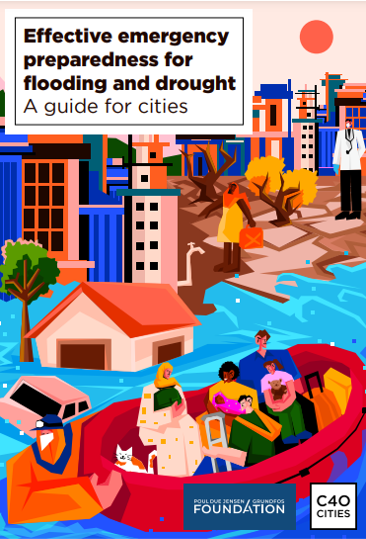
Effective emergency preparedness for flooding and drought: A guide for cities

Effective emergency preparedness for flooding and drought: A guide for cities Implementation Guides – October 2024 DARAJA Case Study, pp. 25-26 Climate-related hazards are growing in intensity and frequency, causing significant loss and damage in cities around the world. Successful emergency preparedness, including the use of early warning systems, is critical to enabling cities and

Effective emergency preparedness for flooding and drought: A guide for cities Read More »

Scroll to Top