Infrastructure and Services

NSET Report 2014: Safer Society

The 2014 Report by National Society for Earthquake Technology -Nepal (NSET) presents an account of NSET’s endeavors and activities towards the enhancement of disaster resilience of communities in Nepal during the past year. The report includes NSET’s initiatives towards i) reducing earthquake risk and building resilience of communities, ii) assisting municipalities in building code implementation in […]

NSET Report 2014: Safer Society Read More »
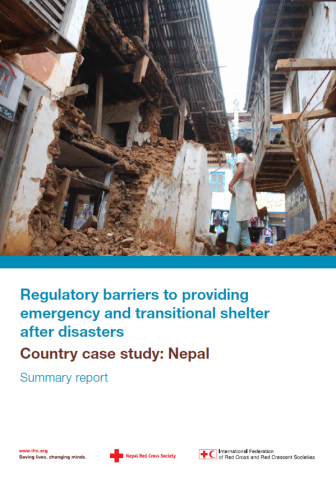
Regulatory barriers to providing emergency and transitional shelter after disasters in Nepal

On June 11th, the Nepal Department of Urban Development and Building Construction (DUDBC) convened partners to launch a new study by the International Federation of Red Cross and Red Crescent Societies (IFRC) on “Regulatory barriers to providing emergency and transitional shelter after disasters” in Nepal. This study, undertaken by the IFRC’s Disaster Law Programme and

Regulatory barriers to providing emergency and transitional shelter after disasters in Nepal Read More »

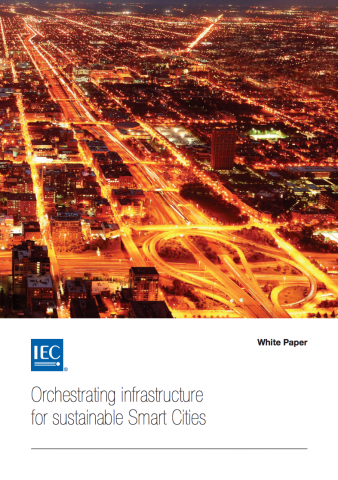
Orchestrating infrastructure for sustainable Smart Cities

This White Paper is the fifth in a series whose purpose is to ensure that the IEC can continue through its International Standards and Conformity Assessment services to solve global problems in electrotechnology. The White Papers are developed by the IEC MSB (Market Strategy Board), responsible for analyzing and understanding the IEC’s stakeholder environment, so

Orchestrating infrastructure for sustainable Smart Cities Read More »

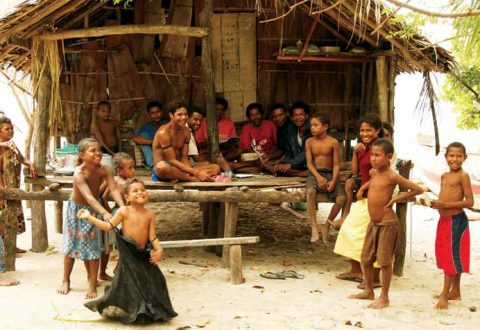
On the Front Line of Climate Change and Displacement: Learning From and With Pacific Island Countries

The Pacific Island countries are internationally regarded as a barometer for the early impacts of climate change. Their geophysical characteristics, demographic patterns and location in the Pacific Ocean make them particularly vulnerable to the effects of global warming. Small Island Developing States, a UN-established category which includes most Pacific Island countries, are characterized by a

On the Front Line of Climate Change and Displacement: Learning From and With Pacific Island Countries Read More »

Azerbaijan: Feeling the pulse of water

This documentary has been produced by IOM Mission in Azerbaijan, with the financial support received from Korea International Cooperation Agency (KOICA), within the “Kahriz Rehabilitation Project”. It features the project implementation process with various positive impacts brought to the rural communities in Azerbaijan, along with the demonstration of the kahriz history, structure and renovation works.

Azerbaijan: Feeling the pulse of water Read More »

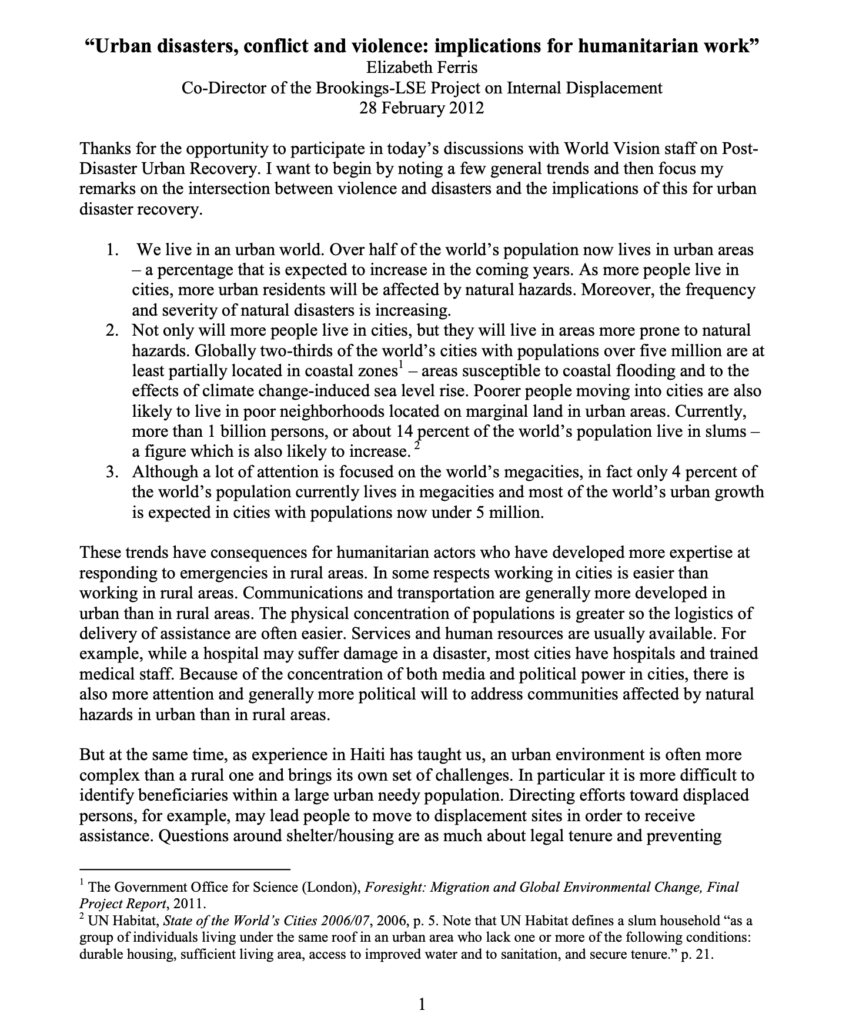
Urban disasters, conflict and violence: implications for humanitarian work

Elizabeth Ferris, Co-Director of the Brookings-LSE Project on Internal Displacement, remarks on the intersection between violence and disasters, and its implications for humanitarian response in urban settings. She cites the experiences and challenges of ICRC and other humanitarian organizations in addressing interpersonal and gang-related violence in post-disaster urban settings. She concludes by posing broader and

Urban disasters, conflict and violence: implications for humanitarian work Read More »

Scroll to Top