
Risk Governance or Risky Governance? Delhi’s Urban Utility Governance Landscape and Heatwaves

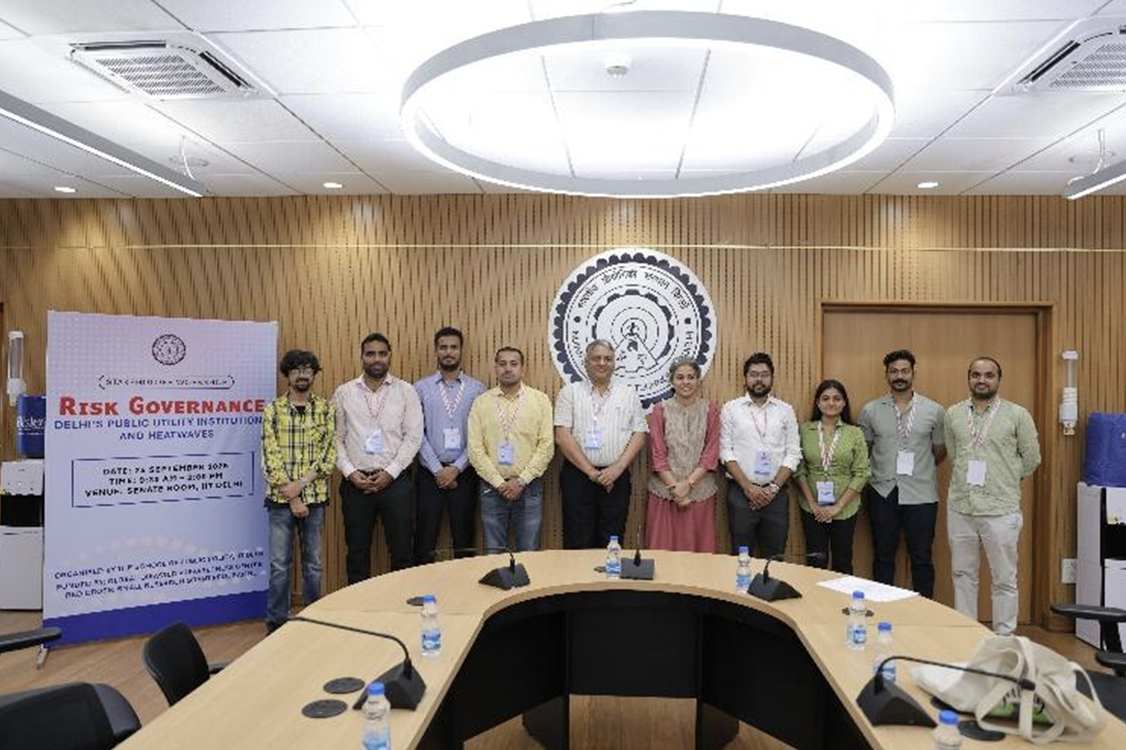
Authors and Collaborators:
-
Anshu Ogra, Indian Institute of Technology, Delhi
-
Nistha Kanodia, Indian Institute of Technology, Delhi
Summary:
Delhi’s record-breaking heat in May 2024—followed within weeks by extreme early-monsoon rainfall—exposed not only a meteorological hazard but a governance challenge: residents’ capacity to stay safe depends on who controls water, where, and through what procedures. This report examines how routine utility governance produces differentiated heat risk in Delhi, focusing on the Delhi Jal Board (DJB) and its interfaces with municipal bodies, revenue administration, and other corridor-owning agencies. Using an institutional-mapping approach grounded in the feminist science-studies concept of situated knowledge, the study combines 21 semi-structured interviews across administrative tiers, targeted site visits to critical assets and offices (including Wazirabad Water Treatment Plant), GIS overlay mapping of administrative and operational geographies, and a multi-agency co-design workshop. Across methods, a consistent mechanism emerges from boundary mismatch. DJB’s hydraulic command zones, engineering divisions, municipal wards, revenue districts, and political constituencies rarely align, converting routine works into multi-jurisdiction negotiations, elongating permission cycles, and diffusing accountability. These seams become most consequential during heat seasons, when demand spikes, complaint volumes surge, and time windows narrow—turning delays that may be tolerable in mild periods into direct pathways to vulnerability (missed supply windows, heavier reliance on tankers/tubewells, and greater contestation at fixed points). The report concludes that effective heat-risk governance must start at these everyday seams—through shared operational maps, time-aware single-window clearances, stabilized internal routing and records, critical-node power redundancy, and seasonal playbooks—rather than treating heat as a standalone disaster response problem.
Note:
GDPC encourages our partner researchers to submit their finished work to academic journals. To facilitate this process, some reports may not be made available in their entirety until after journal acceptance and publication. However, we make available the Executive Summary of the research and will update this resource page with the full report when it becomes available.

This research was part of a multi-country research initiative led by the Global Disaster Preparedness Center of the American Red Cross. Access all final publications here.