
Community Engagement and Accountability

Community Engagement and Accountability includes risk communication, behavior change, according to IFRC guidelines.

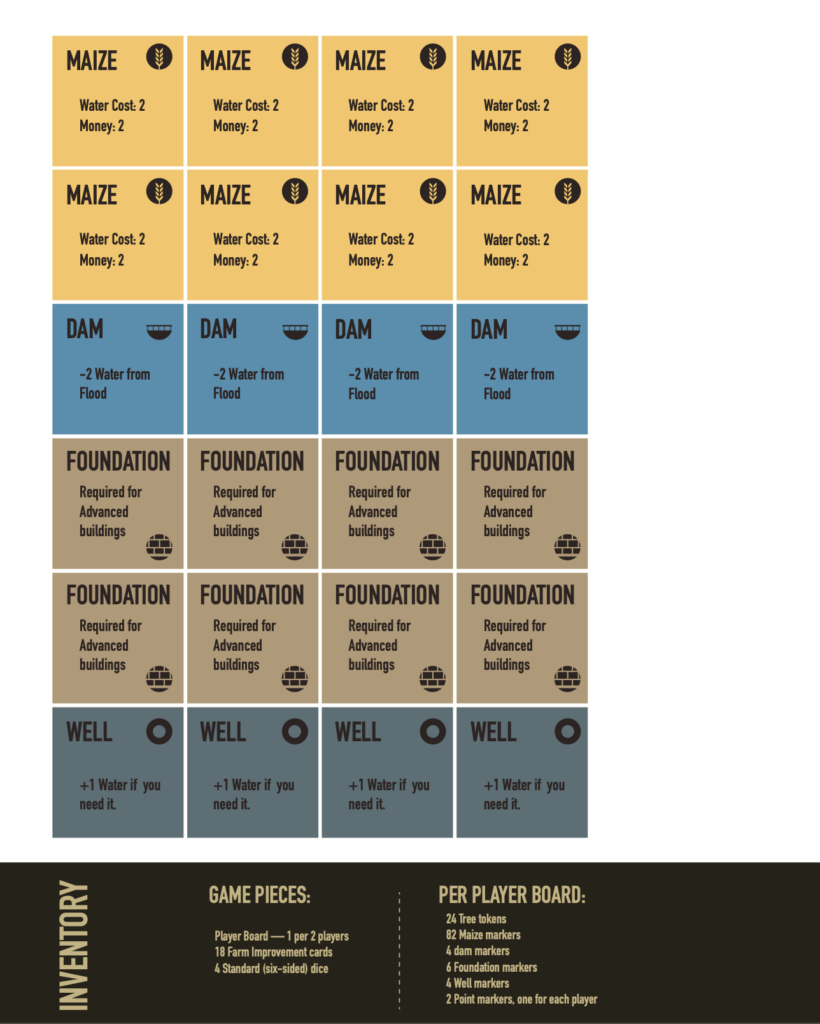
Card sheet for 'The Upstream-Downstream Game' showing four rows of gameplay cards — 8 yellow 'Maize' cards (Water Cost: 2, Money: 2), 4 blue 'Dam' cards (-2 Water from Flood), 8 tan 'Foundation' cards (required for advanced buildings), and 4 gray 'Well' cards (+1 Water if needed) — followed by a black inventory panel listing game pieces (player boards, farm improvement cards, dice) and per-player board components (tree tokens, maize markers, dam markers, foundation markers, well markers, and point markers).

The Upstream-Downstream Game

The game centres on climate-related information in decision-making at the community level, and how neighbouring upstream and downstream communities can work together to manage consequences of flood, drought and deforestation.  Upstream Downstream is an interactive serious game developed to help participants explore the complex relationships between natural resource management, environmental stewardship, and community resilience. Originally […]

The Upstream-Downstream Game Read More »

Behaviour change communication (BCC) for community-based volunteers: Trainer’s manual

Behaviour change communication (BCC) can be a very effective way to combat public health problems by encouraging health behaviour changes. The information in this manual is intended to help prepare you to facilitate the BCC learning sessions so as to build the capacity of volunteers to work to change behaviour in their communities.   IFRC,

Behaviour change communication (BCC) for community-based volunteers: Trainer’s manual Read More »

The Gender and Climate Game

A participatory activity to support experiential learning and dialogue on the differential vulnerability of women and men facing climate variability and change. Players first take on the role of subsistence farmers facing changing risks — then ‘walk in the shoes’ of a specific gender role. Experiencing the consequences of individual and collective decisions, rich discussions

The Gender and Climate Game Read More »

Responding to urban disasters: Learning from previous relief and recovery operations (ALNAP, 2012)

This 2012 ALNAP paper on urban lessons was written by David Sanderson, Paul Knox-Clarke and Leah Campbell and builds off a prior 2009 study written by Ian O’Donnell, Kristin Smart and Ben Ramalingam. It offers lessons pertaining to effective design and implementation of urban-response programs. It was written to serve as a practical field resource for international disaster management professionals,

Responding to urban disasters: Learning from previous relief and recovery operations (ALNAP, 2012) Read More »

Community Engagement and Accountability

Community engagement is essential to effective disaster preparedness and response efforts. Evidence shows that accounting for local knowledge, practices, and contexts helps reduce disaster risks and strength resilience. True collaboration between crisis-affected communities, humanitarian organizations and, where possible, within and between communities enables affected people to meet their needs, address their vulnerabilities and build on

Community Engagement and Accountability Read More »

Scroll to Top