Europe and Central Asia

Community members in Bangladesh take part in a disaster preparedness drill, carrying the Bangladesh Red Crescent and national flags through a flooded area. The exercise highlights the role of anticipatory action and pre-financing in enabling swift early response to coastal hazards.

Prefinanciación de la Acción Anticipatoria: Guía práctica para las sociedades nacionales

La acción anticipatoria está creciendo y consolidándose como un enfoque transversal en todo el Movimiento Internacional de la Cruz Roja y de la Media Luna Roja. A medida que las Sociedades Nacionales desarrollan más Protocolos de Acción Temprana (PAT) y amplían sus programas de acción anticipatoria, contar con una estrategia de prefinanciación para la acción […]

Prefinanciación de la Acción Anticipatoria: Guía práctica para las sociedades nacionales Read More »

HELPify Bulgaria: Bridging the Digital Divide to Empower Vulnerable Communities in Rural Tsenovo — An Impact Story from the Localized Innovation Fund

This impact story describes HELPify (Humanitarian Empowerment & Local Partnerships), an initiative led by the Bulgarian Red Cross (BRC) with support from the Canadian Red Cross’s Local Innovation Fund (LIF) in the rural municipality of Tsenovo, Ruse region, carried out between July and December 2024. It responded to the exclusion of vulnerable populations: older adults,

HELPify Bulgaria: Bridging the Digital Divide to Empower Vulnerable Communities in Rural Tsenovo — An Impact Story from the Localized Innovation Fund Read More »

Contingency Planning as a Continuous Learning Process: Lessons from Canadian Red Cross Technical Support in Central Asia — A Case Study from Tajikistan

This case study documents how the Red Crescent Society of Tajikistan (RCST) strengthened its Disaster Risk Management (DRM) systems by developing a scenario-based, multi-hazard contingency plan and a new DRM Policy, with remote and in-country technical support from the Canadian Red Cross and IFRC under the ECHO Pilot Programmatic Partnership (PPP). Building on a completed

Contingency Planning as a Continuous Learning Process: Lessons from Canadian Red Cross Technical Support in Central Asia — A Case Study from Tajikistan Read More »

Fortalecimiento de los Sistemas de Alerta Temprana para Todos: Evidencia y Lecciones de las Comunidades de Última Milla

Las alertas tempranas salvan vidas, pero solo cuando llegan a tiempo, son confiables y conducen a la acción. Este informe reúne evidencia de 15 estudios en 14 países para analizar por qué los sistemas de alerta temprana (SAT) a menudo no logran traducir las alertas en medidas de protección para las comunidades de última milla

Fortalecimiento de los Sistemas de Alerta Temprana para Todos: Evidencia y Lecciones de las Comunidades de Última Milla Read More »

“Migrants Expect the Red Cross to be there”: Exploring Red Cross and Red Crescent continuity of care along migration routes

This report outlines findings from research commissioned by the The Global Disaster Preparedness Center (GDPC) exploring opportunities to support continuity of care along migration routes. The term “continuity of care” refers to consistent and connected assistance at different stages, and at different locations, along migration journeys. This was understood as applying to National Society programmes

“Migrants Expect the Red Cross to be there”: Exploring Red Cross and Red Crescent continuity of care along migration routes Read More »

A silhouetted community volunteer uses a megaphone to deliver an early warning message outdoors, with sunlight behind them against a clear sky.

Strengthening Early Warning Systems for All: Evidence and Lessons from Last-Mile Communities

This report synthesizes findings from 15 GDPC-supported studies across 14 countries to examine why early warnings often fail to translate into timely, protective action — particularly for last-mile communities that are geographically isolated, socially marginalized, or economically vulnerable. Drawing on empirical research and complementary literature, the report highlights that early warning effectiveness is shaped not

Strengthening Early Warning Systems for All: Evidence and Lessons from Last-Mile Communities Read More »

Management of Earthquake Risk in the European Union

Several countries in the European Union (EU) face significant earthquake risk, primarily due to seismic hazard levels and aging infrastructure. Unlike many other natural hazards, earthquakes occur without warning, limiting the ability to evacuate people and protect lives. At the same time, decades can pass between large earthquakes, leading to a decline in public awareness and policy attention

Management of Earthquake Risk in the European Union Read More »

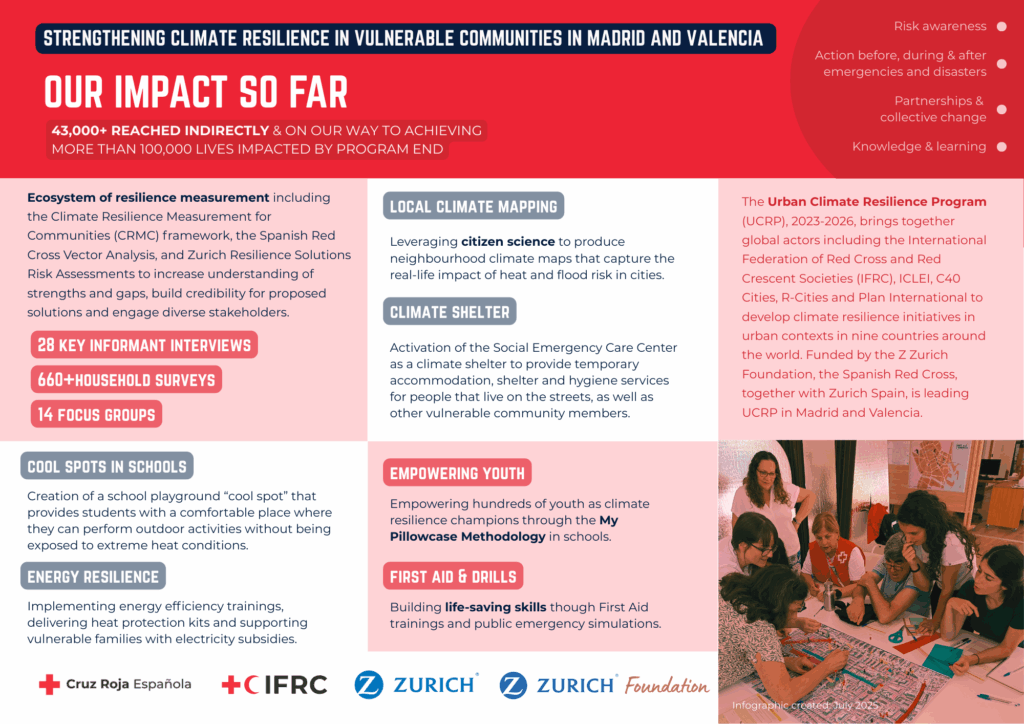
Enhancing Community Resilience to Climate Risks in Madrid and Valencia

Since 2023, Spanish Red Cross has led the Urban Climate Resilience Program (UCRP) in Madrid and Valencia, working with communities most affected by extreme heat and floods. As extreme weather grows more frequent and severe, the program supports people and cities to prepare, adapt, and thrive. This infographic highlights key achievements to date, spanning both

Enhancing Community Resilience to Climate Risks in Madrid and Valencia Read More »

Scroll to Top