Climate Change Adaptation

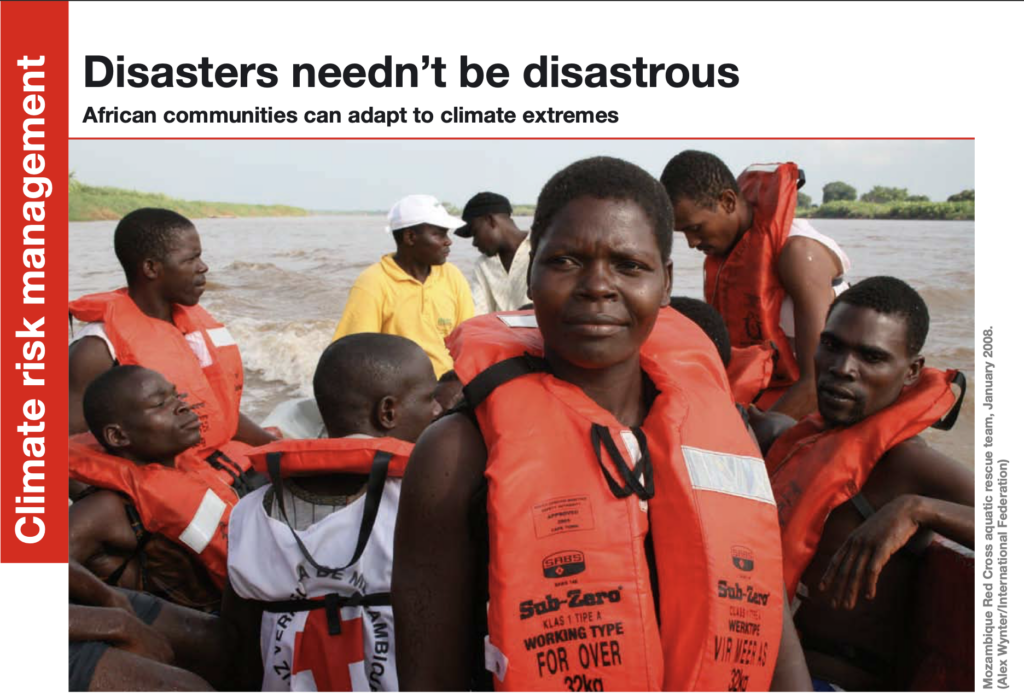
Report cover titled 'Disasters needn't be disastrous: African communities can adapt to climate extremes,' under the section heading 'Climate risk management.' The photo shows a group of people wearing orange life jackets aboard a boat on a river, part of a Mozambique Red Cross aquatic rescue team, January 2008

Disasters needn’t be disastrous – African communities can adapt to climate extremes

‘Early Warning Early Action’ that encompasses scientific advances from climate research and experience with risk reduction now offers the best hope of making humanitarian action in Africa more timely and effective, says the Red Cross Red Crescent Climate Centre. Local disaster managers’ awareness that National Societies will increasingly be confronted with the impacts of climate

Disasters needn’t be disastrous – African communities can adapt to climate extremes Read More »

Bridging the gap: Integrating climate change and disaster risk reduction

The climate is changing and communities in some countries are already feeling the heat. Climate information in the form of trends and forecasts, combined with tried and tested disaster risk reduction measures, can help anticipate disasters before they happen and enable communities to prepare for and cope with them. Fundamental to this approach is strengthening

Bridging the gap: Integrating climate change and disaster risk reduction Read More »

The Access and Use of Climate and Weather Information in the International Federation of Red Cross and Red Crescent Societies: Initial observations from the field

In December of 2007 the International Research Institute for Climate and Society (IRI) at Columbia University’s Earth Institute formed a partnership with the Interna­tional Federation of Red Cross and Red Crescent Societies (IFRC). The Red Cross Red Crescent (RC/RC) Climate Centre helps facilitate the effort to provide the IFRC with tools and support to improve

The Access and Use of Climate and Weather Information in the International Federation of Red Cross and Red Crescent Societies: Initial observations from the field Read More »

Scroll to Top