Asia Pacific

A silhouetted community volunteer uses a megaphone to deliver an early warning message outdoors, with sunlight behind them against a clear sky.

Strengthening Early Warning Systems for All: Evidence and Lessons from Last-Mile Communities

This report synthesizes findings from 15 GDPC-supported studies across 14 countries to examine why early warnings often fail to translate into timely, protective action — particularly for last-mile communities that are geographically isolated, socially marginalized, or economically vulnerable. Drawing on empirical research and complementary literature, the report highlights that early warning effectiveness is shaped not

Strengthening Early Warning Systems for All: Evidence and Lessons from Last-Mile Communities Read More »

When Form Follows Nature: Presence, Climate, and the Ethics of Space

Form follows nature. Not as slogan. As method. In an age of climate emergency, urban intensification, and sensory saturation, this principle becomes resistance. It invites us to pause—not to impose geometry, but to observe ecology. To trace the shifting patterns of light, wind, and memory. To let trees instruct. To let people inhabit. This is

When Form Follows Nature: Presence, Climate, and the Ethics of Space Read More »

Strengthening Climate Resilience in Vulnerable Communities in Western Sydney

Since 2023, Australian Red Cross has led the Urban Climate Resilience Program (UCRP) in Western Sydney, working with communities most affected by extreme heat. As extreme weather grows more frequent and severe, the program supports people and cities to prepare, adapt, and thrive. This infographic highlights key achievements to date, spanning both local action and

Strengthening Climate Resilience in Vulnerable Communities in Western Sydney Read More »

Forced to Flee in a Changing Climate: How IFRC is addressing climate and disaster displacement in Asia Pacific

This IFRC report highlights how climate change and disasters are driving displacement across Asia Pacific, the world’s most disaster-prone region. In 2024 alone, over 24 million people were displaced by disasters, accounting for more than half of the global total. Through 39 case studies from 21 National Societies, the report showcases locally led Red Cross

Forced to Flee in a Changing Climate: How IFRC is addressing climate and disaster displacement in Asia Pacific Read More »

Increasing healthcare continuity during floods – Solutions Brief

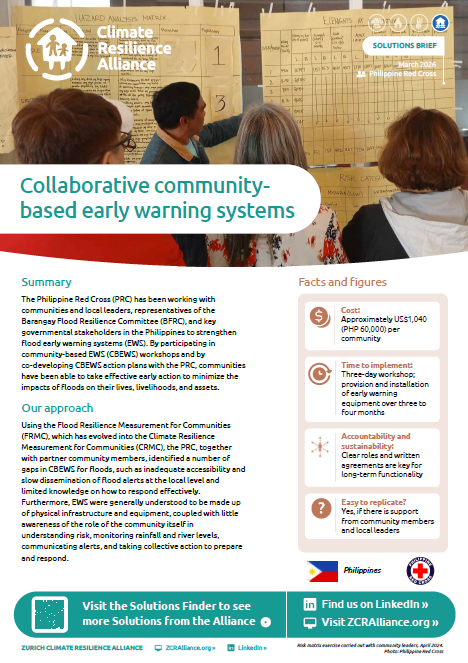
This solution brief forms part of the Zurich Climate Resilience Alliance’s solutions series. The solution series aims to improve outreach and impact of such resilient practices at a global level. This brief explores how the Philippine Red Cross has worked to strengthen local capacity and increase healthcare continuity during floods. This resource presents the process

Increasing healthcare continuity during floods – Solutions Brief Read More »

Localized early warning voice messages – Solutions brief

Based on Climate Resilience Measurement for Communities (CRMC) data and community input, Practical Action identified a need for flood early warning messages to reach the most vulnerable in Faridpur District, Bangladesh. Using information from the national forecast, Practical Action develops understandable and actionable voice messages and sends them to registered mobile phone numbers to warn

Localized early warning voice messages – Solutions brief Read More »

Metropolitan Adelaide urban heat mapping 2022

Unpacking the Summer: Learning About Heat in Adelaide

Listening Over Coffee: Stories Behind the Data  The Post-Event Review Capability (PERC), developed by the Zurich Climate Resilience Alliance, offers a structured approach to understanding how and why hazard events escalate into disasters. In South Australia, this framework is being put into action to unpack the complexities of heat in an urban context. The Adelaide

Unpacking the Summer: Learning About Heat in Adelaide Read More »

Scorched Future: The Rising Toll of Extreme Heat in the Philippines

  Authors: Mia Grace Ligutan, Seth Sarmiento, Steven Villena, Cale Johnstone Rising temperatures in the Philippines, particularly in urban areas like Metro Manila, present growing health and economic risks. Many remain unaware of extreme heat as a serious threat. The Philippine Red Cross is actively enhancing resilience through education, early warning systems and community engagement.

Scorched Future: The Rising Toll of Extreme Heat in the Philippines Read More »

Scroll to Top