Livelihoods and Food Security

Case study 5 – Strengthening Value Chain Committee’s capacities in the municipality of Somoto: Partners for Resilience’s experience in Nicaragua

For centuries, the ovens in Somoto, in the department of Madriz, Nicaragua, have been baking the distinctive handmade rosquillas (ring-shaped pastry), prepared by hardworking women. These women still preserve the artisan traditions in their 137 shops where they continue preparing the delicious Somoteñan rosquillas, which many consider unique in the world, to such an extent […]

Case study 5 – Strengthening Value Chain Committee’s capacities in the municipality of Somoto: Partners for Resilience’s experience in Nicaragua Read More »

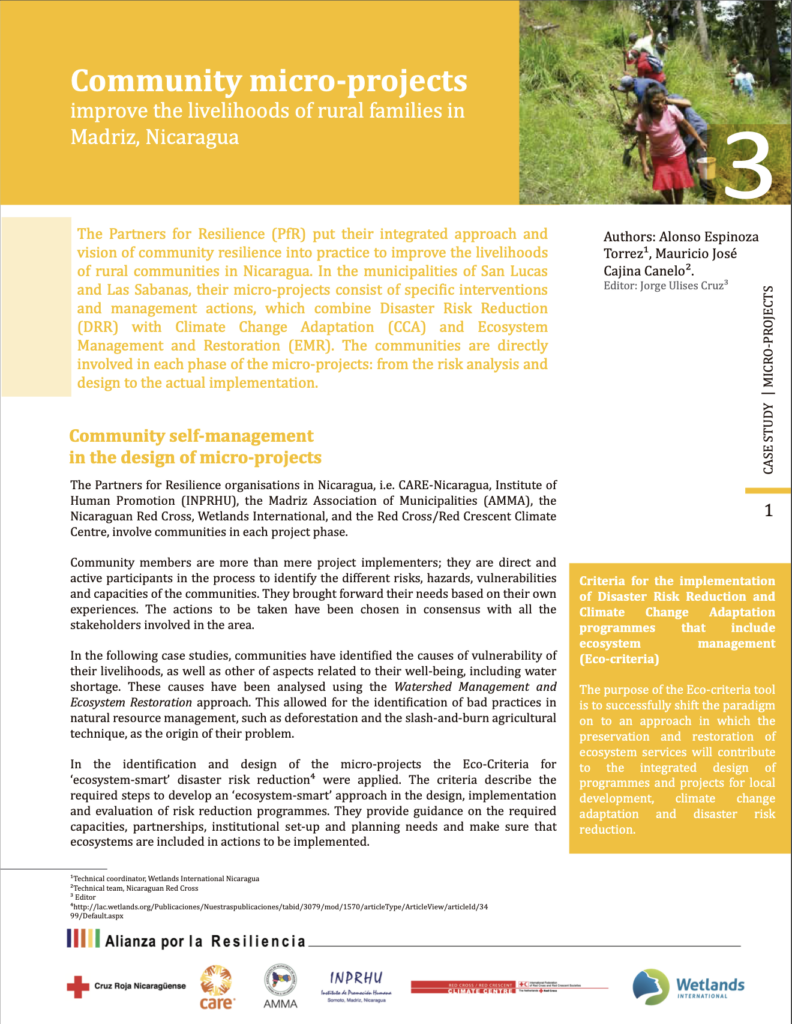
Case study 3 – Community micro-projects improve the livelihoods of rural families in Madriz, Nicaragua

The Partners for Resilience (PfR) put their integrated approach and vision of community resilience into practice to improve the livelihoods of rural communities in Nicaragua. In the municipalities of San Lucas and Las Sabanas, their micro-projects consist of specific interventions and management actions, which combine Disaster Risk Reduction (DRR) with Climate Change Adaptation (CCA) and

Case study 3 – Community micro-projects improve the livelihoods of rural families in Madriz, Nicaragua Read More »

Questioning ‘drought displacement’: environment, politics and migration in Somalia

This report by Anna Lindley, Lecturer in Migration and Development at SOAS, University of London, focuses on the humanitarian crisis in Somalia and the environmental, political, and structural dimensions and processes underlying it. The multi-causal factors of recent displacement and migration “prompt a series of policy challenges in relation to prevention, response and rights protection.”  

Questioning ‘drought displacement’: environment, politics and migration in Somalia Read More »

IASC Operational Guidelines and Manual on Human Rights and Natural Disasters

In order to provide guidance on how to protect the rights of individuals affected by natural disasters, in June 2006, the UN Inter-Agency Standing Committee (IASC) adopted Operational Guidelines on Human Rights and Natural Disasters. These guidelines were needed because already existing guidelines on humanitarian action in emergencies, as well as standards for protecting human

IASC Operational Guidelines and Manual on Human Rights and Natural Disasters Read More »

On the Front Line of Climate Change and Displacement: Learning From and With Pacific Island Countries

The Pacific Island countries are internationally regarded as a barometer for the early impacts of climate change. Their geophysical characteristics, demographic patterns and location in the Pacific Ocean make them particularly vulnerable to the effects of global warming. Small Island Developing States, a UN-established category which includes most Pacific Island countries, are characterized by a

On the Front Line of Climate Change and Displacement: Learning From and With Pacific Island Countries Read More »

Azerbaijan: Feeling the pulse of water

This documentary has been produced by IOM Mission in Azerbaijan, with the financial support received from Korea International Cooperation Agency (KOICA), within the “Kahriz Rehabilitation Project”. It features the project implementation process with various positive impacts brought to the rural communities in Azerbaijan, along with the demonstration of the kahriz history, structure and renovation works.

Azerbaijan: Feeling the pulse of water Read More »

Climate change, natural disasters, and human displacement: a UNHCR perspective

This report contains UNHCR’s preliminary perpsectives on the complex and evolving nexus between climate change displacement and cross-border movements within the current international framework. It addresses a range of displacement scenarios and challenges, including the case of ‘sinking’ small island states and refugee movements provoked by armed conflict rooted in environmental factors. In addition, this

Climate change, natural disasters, and human displacement: a UNHCR perspective Read More »

Climate Change’s Impact On World’s Future Food Supply

An infographic released by the United Nation’s Food and Agriculture Organization details the impact climate change will have global food production in the decades to come. The Inforgraphichttp://image.guardian.co.uk/sys-image… Subscribe to The Daily Conversationhttp://bit.ly/WZnLndJoin the conversation on Facebookhttp://www.facebook.com/thedailyconve…Add TDC to your circles on Google+https://plus.google.com/1001349258045…Follow The Daily Conversation on Twitterhttp://www.twitter.com/thedailyconvo

Climate Change’s Impact On World’s Future Food Supply Read More »

Horn of Africa food crisis

The Ethiopian government and its humanitarian partners in the country say nearly 5 million people require emergency food-aid this year, outside the governments own safety net programme. An additional 1.2 million mothers and children under five there will require supplementary feeding. The International Federations Addis Ababa-based operations team is now working with the Ethiopian Red

Horn of Africa food crisis Read More »

The Global Food Crisis

We developed this short video as a way of communicating an important message in a simple way – our food system is broken. We need to fix it. Our central issue today is not the global financial crisis but whether we can produce enough food for civilisation to survive when faced with a rising population,

The Global Food Crisis Read More »

Scroll to Top