
Global Disaster Preparedness Center
gdpc@redcross.org

Video

This 4-min video overview of the sanitation business model in Indonesia illustrates a one-stop shop sanitation business model targeted at entrepreneurs and other stakeholders. The video animation follows Mr. Budi, a sanitation entrepreneur who prod...
Video
NIAMEY, Niger, 17 July 2008 — The latest UNICEF-World Health Programme Joint Monitoring Programme report focuses on sanitation improvements. The report finds that while more people are drinking water from safe sources, far too few are using imp...
Video
n Timor-Leste, only 36 per of rural households have access to basic levels of sanitation. Nearly a third of the population have no choice but to collect dirty water from unsafe sources. Poor hygiene practices remain widespread and diarrhoea is preval...
Video
http://www.worldbank.org/we – In one of the most densely populated areas in the world, the need for a dependable water supply is critical in the Gaza Strip. The scarce water resources presents a major humanitarian and development challenge. Th...
Case Study, Report
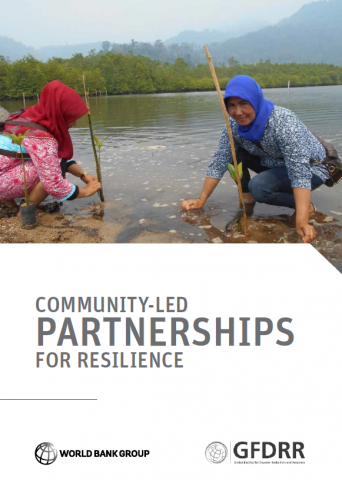
Organized communities living and working in hazard prone settlements bring perspectives and priorities to policy discussions that are distinct from the rest of civil society. This report documents a number of case studies where grassroots women’s o...
Guidance material
This publication, a supplement to the previously published “Public awareness and education for disaster risk reduction: a guide”, is offered as a tool for practitioners internationally to use in a consensus-building validation process. Na...
Other type of resource
Scaling urban and community resilience: A strategy for global action This strategy paper outlines the concept for a collective global initiative on urban and community resilience. The goal is to encourage and enable a much greater number of communiti...
Assessment or evaluation
From 2010 – 2011 the Uganda Red Cross Society (URCS), with support from the American Red Cross (ARC), implemented a disaster risk reduction project (DRR) in the Teso sub-region of Eastern Uganda. Known informally as the “Katakwi DRR Projec...
Research
This peer-reviewed journal article presents a computational framework for predicting and simulating population movements following large-scale natural disasters, developed through analysis of big and heterogeneous data from Japan. Using GPS records f...