community mobilization

ethics in stem

Valuing what works – Success Factors in Disaster Preparedness

This report summarizes an 18-month, evidence-based study that sought to understand practitioner information needs by asking the question: What are successful Red Cross/Red Crescent (RCRC) preparedness practitioners already doing that works, and how can the organization better support their information needs in what they are already doing? A research team from the University of Washington conducted

Valuing what works – Success Factors in Disaster Preparedness Read More »

Community Monitoring of Development Projects

DevelopmentCheck is a user driven and solution oriented online tool for citizen feedback on the transparency, participation and effectiveness of development projects. The community identifies priority development projects to monitor and then collects data on these through project site visits, beneficiary surveys, information requests and photos. They enter the data for each project monitored into

Community Monitoring of Development Projects Read More »

The Minimum Standards for local climate‐smart disaster risk reduction

Many national climate change adaptation plans consider the need to plan over various timescales and acknowledge the essential role of local communities in addressing the changing risks. The Minimum Standards for local climate‐smart disaster risk reduction were developed as a practical checklist to help local community leaders and DRR practitioners ensure their risk reduction efforts are climate‐smart and contribute to

The Minimum Standards for local climate‐smart disaster risk reduction Read More »

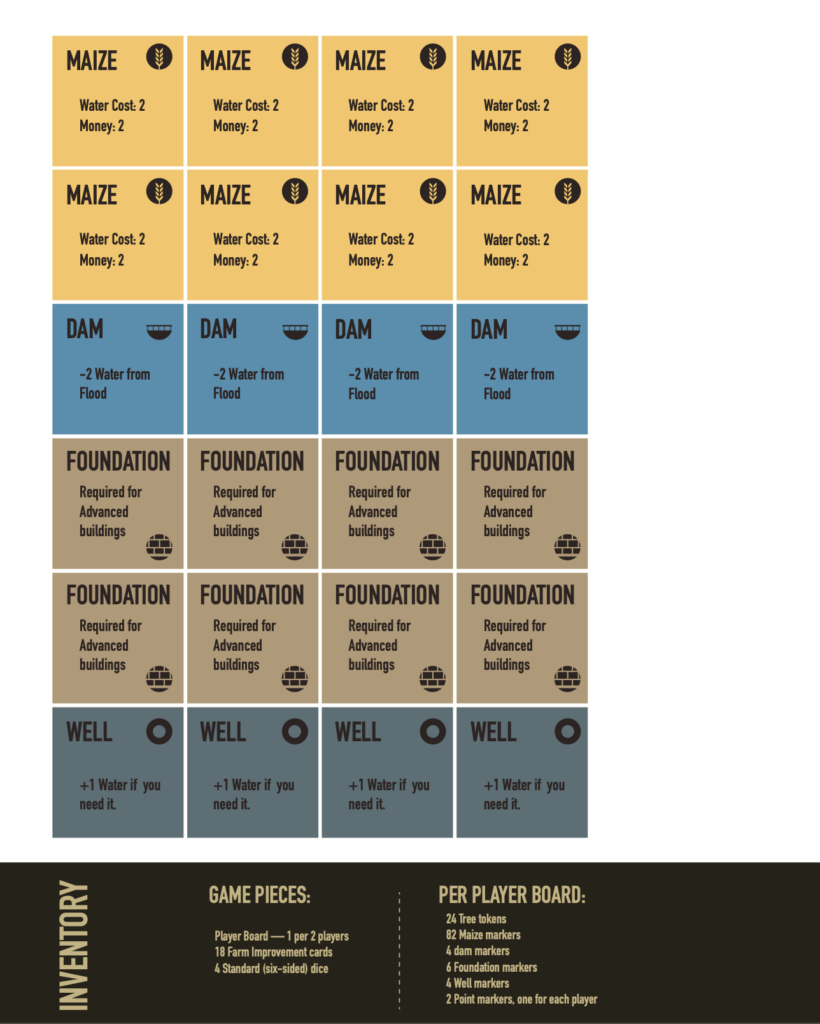
Card sheet for 'The Upstream-Downstream Game' showing four rows of gameplay cards — 8 yellow 'Maize' cards (Water Cost: 2, Money: 2), 4 blue 'Dam' cards (-2 Water from Flood), 8 tan 'Foundation' cards (required for advanced buildings), and 4 gray 'Well' cards (+1 Water if needed) — followed by a black inventory panel listing game pieces (player boards, farm improvement cards, dice) and per-player board components (tree tokens, maize markers, dam markers, foundation markers, well markers, and point markers).

The Upstream-Downstream Game

The game centres on climate-related information in decision-making at the community level, and how neighbouring upstream and downstream communities can work together to manage consequences of flood, drought and deforestation.  Upstream Downstream is an interactive serious game developed to help participants explore the complex relationships between natural resource management, environmental stewardship, and community resilience. Originally

The Upstream-Downstream Game Read More »

Scroll to Top