Common Alerting Protocol – Workshop 2018
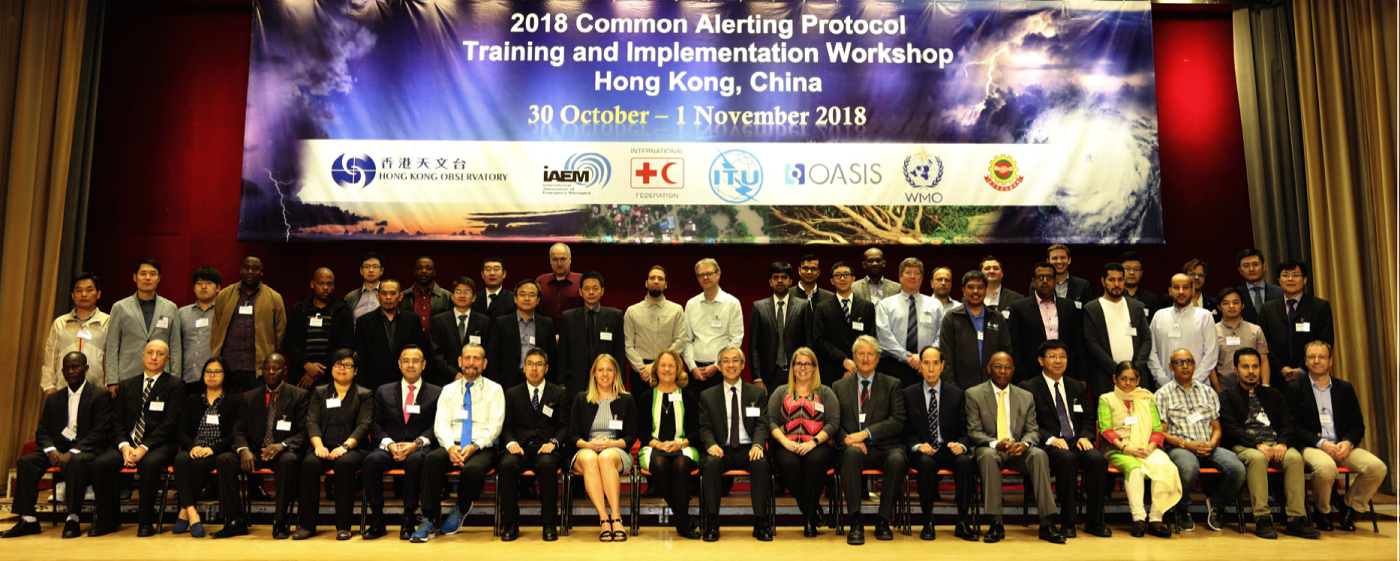
The 2018 CAP Implementation Workshop was held 31 October – 1 November, in Hong Kong, China. The Workshop was hosted by Hong Kong Observatory (HKO) and co-sponsored by the International Association of Emergency Managers (IAEM), the International Federation of Red Cross and Red Crescent Societies (IFRC), the International Telecommunication Union (ITU), the OASIS standards organization, and the World Meteorological Organization (WMO).
Participants:
The Workshop was a technical meeting intended solely for information sharing among 57 experts from 25 countries: Austria, Botswana, Canada, China, Comoros, Germany, Guinea-Bissau, India, Italy, Malaysia, Mexico, Nepal, Netherlands, Philippines, Republic of Korea, Saudi Arabia, South Africa, Sri Lanka, Switzerland, Thailand, The Gambia, United Kingdom, United States, and Zimbabwe.
Find the list of speakers and participants.
Topics:
The Common Alerting Protocol Workshop had an intensive programme. Find the presentations and experiences shared on the two day workshop.
Conferences:
- AccuWeather and CAP (Dan DePodwin)
- Architecture of a Global-scale Alert Hub (Ian Ibbotson.
- CAP and Mobile Multimedia Alerting (Menno Bot)
- CAP and Natural Disasters (Efraim Petel)
- CAP in the Regional Integrated Multi-Hazard Early Warning System (Jeiann Ermac)
- China’s National Early Warning Release System (Jinjun Pan)
- IFRC Perspective on CAP Alert Hubs (Omar Abou-Samra)
- Indigenous Language Alerts with CAP (Rob Hopkins)
- Integrated Public Alert and Warning System (May Wu)
- An Issuing Authority Perspective on Using CAP (Norm Paulsen)
- ITU and Emergency Telecommunications (Vanessa Gray)
- The New Severe Weather Information Center Website (Armstrong Cheng)
- Overview of Meteoalarm and CAP Implementation (Andreas Schaffhauser)
- WMO Perspectives on CAP Implementation Worldwide (Samuel Muchemi)
- Update on OASIS Emergency Management Technical Committee Work (Elysa Jones).
Country experiences:
- CAP Implementation in India (Sabyasachi Majumdar and Arun Yadav)
- CAP Implementation in Italy 2018 (Marcello Marzoli)
- CAP Implementation in Mexico 2018 (Mario Ruiz)
- CAP Implementation in the Comoros Islands (Fouad Issoufa)
- CAP in Deutscher Wetterdienst (Martin Klink)
- CAP in Philippines (Amel Manoos)
Report:
The final report includes the main conclusions and brief descriptions of the presenations. Download the final document report.
Partnership:
The workshop held in 2018, was made in collaboration with: