Americas

Community-First Approach: How the American Red Cross Helps Build Disaster Resilience Where It’s Needed Most

Across the United States, the American Red Cross is working to reduce disaster risks and strengthen the long-term resilience of the most vulnerable communities through its Community Adaptation Program (CAP). With teams embedded in communities across 19 locations, the program focuses on addressing the root causes of vulnerability — specifically in the areas of health, […]
Community-First Approach: How the American Red Cross Helps Build Disaster Resilience Where It’s Needed Most Read More »

Enhancing People-Centred Early Warning Systems (PCEWS) in Traditional Coastal Communities of Brazil: An Intersectional Approach to Inclusive Risk Communication

About this Paper: This study investigates barriers to accessing and acting on Early Warning Systems (EWS) among traditional coastal communities in southeastern Brazil, focusing on Quilombola and Caiçara groups. These communities face unique challenges, including delayed information, unreliable communication technologies, and misinformation, exacerbated by socio-economic and geographic vulnerabilities. Using a mixed-methods approach, the research engaged

Enhancing People-Centred Early Warning Systems (PCEWS) in Traditional Coastal Communities of Brazil: An Intersectional Approach to Inclusive Risk Communication Read More »

Fact Sheet: Coastal City Resilience and Extreme Heat Action Project (CoCHAP)

The Coastal City Resilience and Extreme Heat Action Project (CoCHAP) Fact Sheet outlines the progress and objectives of this initiative led by the IFRC with funding from USAID/BHA and technical support from the American Red Cross and the RCRC Climate Centre. CoCHAP focuses on building climate resilience in urban communities in nine secondary cities across

Fact Sheet: Coastal City Resilience and Extreme Heat Action Project (CoCHAP) Read More »

From Informality to Impact – The Untapped Potential of Scaling Urban Resilience Innovation in Informality

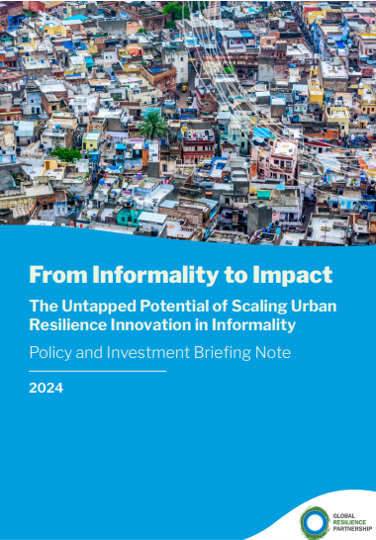
From Informality to Impact – The Untapped Potential of Scaling Urban Resilience Innovation in Informality Policy and Investment Briefing Note 9 November 2024 Currently only 1.2% of urban climate investments flow to climate change adaptation and resilience solutions. Increasing investment flows requires diversifying and strengthening the solution pipeline across different models – for-profit, not-for-profit, private-sector-led and private–public partnerships,

From Informality to Impact – The Untapped Potential of Scaling Urban Resilience Innovation in Informality Read More »

Co-designing solutions for urban resilience action

Coastal Cities and Extreme Heat Project (CoCHAP): Learning Product #1 – Co-Designing Solutions for Urban Resilience This learning product from the CoCHAP project provides an overview of the co-design process for developing solutions to risks and challenges identified through city-wide risk assessments in Tanzania and Honduras. It details the key steps and processes of the

Co-designing solutions for urban resilience action Read More »

Guide Methodologique Sensibilisation et Education à la RRC – PEID

Ce guide méthodologique a été élaboré et conçu afin d’accompagner les praticiens du Mouvement de la Croix-Rouge et du Croissant-Rouge – plus spécifiquement les chefs et coordinateurs de projets et les volontaires – qui travaillent dans le domaine de la Réduction des Risques de Catastrophes (RRC) dans les Petits États Insulaires en Développement (PEID). Le

Guide Methodologique Sensibilisation et Education à la RRC – PEID Read More »

Boîte à Outils Sensibilisation et Education à la RRC – PEID

À propos de la Boîte à Outils Cette boîte à outils a été préparée conjointement avec les équipes de la PIROI (La Réunion/Mayotte), le pôle de la Direction des Relations et Opérations Internationales de la Croix-Rouge française, la Croix-Rouge Allemande basée à Madagascar, et les Sociétés nationales des Comores, de Maurice, des Seychelles, de Madagascar,

Boîte à Outils Sensibilisation et Education à la RRC – PEID Read More »

DRR Awareness and Education Methodology Guide for SIDS

This methodological guide has been designed to support Red Cross and Red Crescent Movement practitioners—specifically project managers, coordinators, and volunteers—working in the field of disaster risk reduction (DRR) education in Small Island Developing States (SIDS). These tools apply a community and school-based disaster risk management approach adapted to the SIDS context, in order to identify

DRR Awareness and Education Methodology Guide for SIDS Read More »

Putting children and youth at the centre of disaster risk reduction and community resilience building

In 2024, the International Day for Disaster Risk Reduction, celebrated on the 13th of October, is focused on the theme of ‘Empowering the next generation for a resilient future’. Today we explore ways in which children and youth have been integrated into and prioritised in climate resilience actions carried out by Red Cross Red Crescent

Putting children and youth at the centre of disaster risk reduction and community resilience building Read More »

Scroll to Top