Post-Disaster Recovery

Psychosocial Recovery Training Toolkit

Training to build understanding of psychosocial recovery to support those working in varied roles in disaster recovery. This training was originally inspired by the need among personnel working on the ground post-earthquake in Christchurch, New Zealand. It ensures volunteers and staff working with people post-disaster: understand the challenges specific to long-term recovery follow best practice […]

Psychosocial Recovery Training Toolkit Read More »
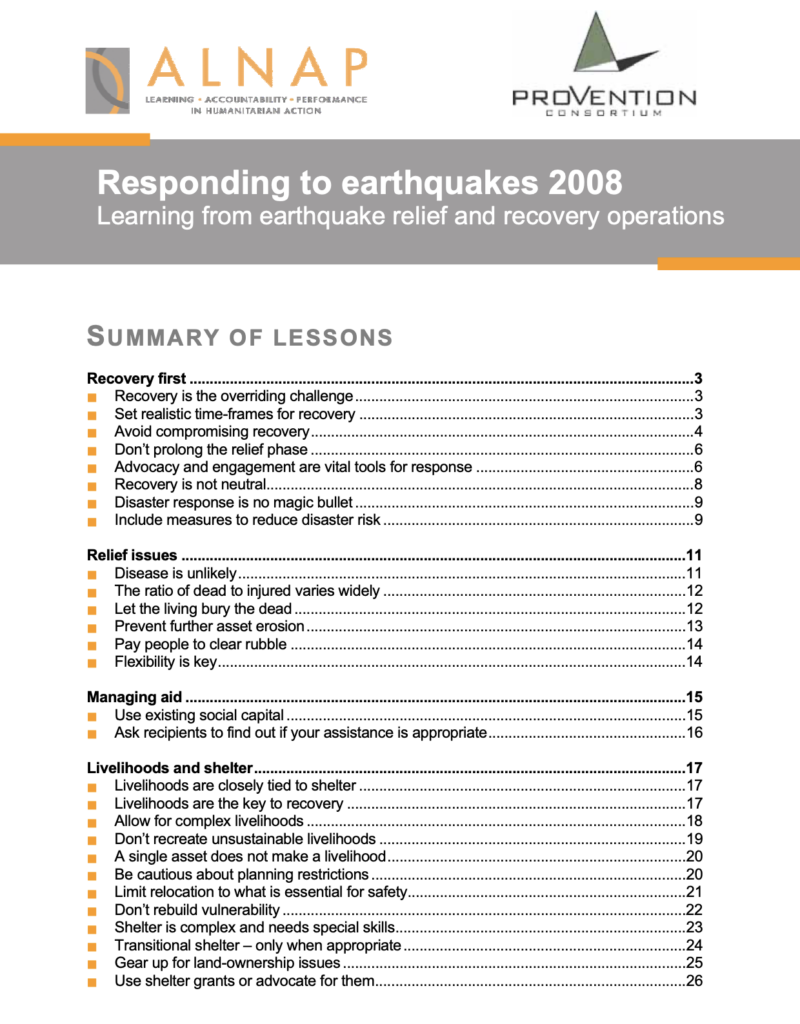
Responding to earthquakes 2008: Learning from earthquake relief and recovery operations

This paper aims to provide a distillation of the learning from thirty years of humanitarian response to earthquakes. It concentrates on issues of particular relevance in earthquakes. The paper assumes that readers are already familiar with the more general lessons in the aid sector such as the key roles of needs assessment, effective coordination, accountability

Responding to earthquakes 2008: Learning from earthquake relief and recovery operations Read More »

The role of information and communication technologies in post conflict reconstruction

This report is concerned with the relationship between information and communication technologies (ICTs) and postconflict reconstruction, especially with ways in which ICTs can be used by governments and donors to support the transition from violence to stability. © 2014 International Bank for Reconstruction and Development / The World Bank

The role of information and communication technologies in post conflict reconstruction Read More »

Gender Perspective: Working Together for Disaster Risk Reduction

This publication, facilitated by the UN/ISDR secretariat, serves as “an introduction to the importance of mainstreaming gender issues in risk and vulnerability reduction.” From its diverse collection of case studies, the report “showcases women’s valuable contributions to community resilience” while highlighting good practices and lessons learned in awareness-raising and capacity-building. Ultimately, this publication aims to

Gender Perspective: Working Together for Disaster Risk Reduction Read More »

Disaster Conflict Interface

The study aims to achieve a comparative analysis of tendencies and experiences that stem from the relationship between disasters and conflict. It also analyses the relative success of existing relevant programming approaches adopted incountry. This comparative analysis aims to: contribute to the body of knowledge on the interactions between disaster and conflict; better understand the

Disaster Conflict Interface Read More »

Market analysis guidance

This publication features processes and tools that can be used to integrate market assessment into the different phases of the project cycle, taking the Movement’s existing technical documents into account whenever possible. It is intended for staff who have a leading role in market assessment, as well as managers who need to make strategic decisions

Market analysis guidance Read More »

Scroll to Top