
Investigating and Scaling-up Effective Nature-Based Solutions for Climate Resilience in Dessie City Administration, Ethiopia

Authors and Collaborators:
- Amogne Asfaw Eshetu
- Abebe Mohammed Ali
- Girma Moges Meshesha
- Abebe Arega Mekonen
- Marie Addis Desta
- Hailu Ayene Kebede
Summary:
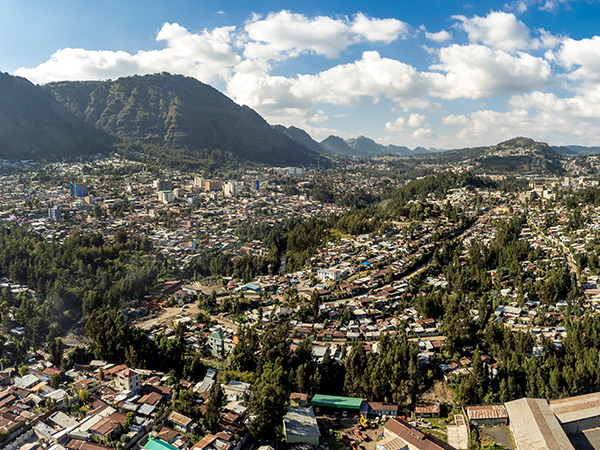
Due to its steep topography, rapid urbanization, and inadequate infrastructure, the Dessie city administration is among the most climate change-sensitive urban centers in Ethiopia where landslides and flooding have been the most catastrophic challenges. To overcome these challenges, innovative and sustainable adaptation measures are required. To that end, Nature-based Solutions (NbS) offer a promising and cost-effective solution by integrating ecological systems into urban development, thereby enhancing resilience while generating environmental and socio-economic co-benefits. Nevertheless, despite local initiatives, the effectiveness and sustainability of NbS in Dessie remain underexplored, mainly with respect to community participation and socio-ecological benefits. This study opted to investigate and scale up effective NbS for climate resilience in Dessie City using a mixed research approach. The main objective of the study was to evaluate the performance of NbS that involves community participation by establishing how people value the benefits gained with NbS; significant challenges encountered and lessons learned in scaling up; best practices, while mapping risk zones for threat reduction and suitability for implementing NbS. Data collection was undertaken using a household-based survey from 305 randomly selected households, in-depth interviews with key informants, focus group discussions, and direct field observation, which were complemented by literature review and the use of geospatial analysis. Data analysis was conducted using descriptive statistics (mean, percentage, and standard deviation), weighted mean values, and the problem confrontation index. The results indicated that although communities perceive the environmental and social benefits of NbS, such as improved air quality, flood control, and livelihood support, their involvement is restricted by a lack of financial resources, high maintenance costs, inaccessibility, safety concerns, weak institutional support, weak coordination among relevant stakeholders, and limited awareness. The GIS-based Multi-Criteria Evaluation (MCE) shows that Dessie City has a moderate risk of flooding (57.6%) and a moderate risk of landslides (34.4%). Almost one-fifth of flood-prone areas and more than 40% of landslide-prone areas are in high to extremely high risk zones. The analysis also shows that 42.4% of the region is very good for NbS. This shows that NbS should be a part of urban development to make cities more resilient through better water management and green infrastructure. We concluded that scaling up NbS requires a holistic policy framework that incorporates allocating financial incentives and sustainable funding mechanisms, strengthening policy support and institutional collaboration, and integrating NbS into municipal development plans with priority for high-risk zones. To overcome the possible risks and scale up best practices, we recommend enhancing community engagement through inclusive planning, capacity building, and awareness campaigns; improving infrastructure for accessibility and safety; allocating financial incentives and sustainable funding mechanisms; strengthening policy support and institutional collaboration; and prioritizing scalable NbS in vulnerable urban zones. This research contributes to narrowing the knowledge gap on the role of NbS in mitigating climate-change-induced hazards in the urban context, particularly in developing countries. Additionally, it provides actionable insights for policymakers and practitioners to foster climate-resilient urban development.
Note:
GDPC encourages our partner researchers to submit their finished work to academic journals. To facilitate this process, some reports may not be made available in their entirety until after journal acceptance and publication. However, we make available the Executive Summary of the research and will update this resource page with the full report when it becomes available.

This research was part of a multi-country research initiative led by the Global Disaster Preparedness Center of the American Red Cross. Access all final publications here.