
Early Warning & Anticipatory Action Resource Hub
IFRC NETWORK
Early Warning & Anticipatory Action Tools and Resources Compendium
A guide to tools, methodologies and other resources to support and advance the IFRC network’s work in early warning and anticipatory action.
About this compendium
Early warning systems and anticipatory action are among the most effective measures to save lives, protect livelihoods, and reduce the costs of disasters. They are also critical for reducing disaster risk and adapting to the impacts of climate change. Yet, despite their proven value, significant global gaps remain — particularly in ensuring that early warnings lead to timely and effective action. National Red Cross and Red Crescent Societies (RCRC NS) can play a critical role in addressing these gaps by helping to strengthen early warning (EW) and anticipatory action (AA) systems with and for at-risk communities.
This compendium brings together tested tools, guidance, and methodologies developed across the RCRC Network. It shows how these resources connect to the four pillars of effective EWS — risk knowledge, monitoring and forecasting, dissemination and communication, and preparedness to respond — providing a practical foundation for strengthening early warning and anticipatory action.
Who is it for?
The compendium is designed primarily for RCRC National Societies seeking to strengthen or expand their work on EW and AA.
It is also valuable for partners, including governments, NGOs, and technical agencies, who wish to better understand and integrate RCRC tools and approaches into their own work.
Why was it developed?
The compendium was created as a practical reference for the IFRC Network and partners.
By curating existing tools and approaches in one place, it helps connect users to adaptable resources, identify entry points for EW and AA programming, prevent duplication, and promote a comprehensive approach across the four EWS pillars.
What does it offer?
The compendium is designed to help users quickly identify and apply relevant tools based on their operational context. Each entry includes a brief description and indicates which EWS pillar(s) it supports, making it easier to select resources aligned with specific needs.
It features a wide range of methodologies, guidance, reports, and digital tools. Click here to learn more about the types of tools and resources included.
IFRC Network’s role in Early Warning and Anticipatory Action
The International Federation of Red Cross and Red Crescent Societies (IFRC) is a global leader in advancing people-centered early warning and anticipatory action. With 191 National Societies, 197,000 local branches, and over 16 million volunteers, the IFRC network bridges the gap between communities and national systems, ensuring people are equipped to act. National RCRC Societies are uniquely positioned to link governments and communities, leveraging their auxiliary role to authorities and their long-term grassroots presence.
Building on decades of experience and feedback from communities and governments, the IFRC Network’s key objectives in EW and AA are to:
- Ensure early warning and anticipatory action are effectively embedded within national and local disaster risk management (DRM) systems.
- Ensure early warnings reach everyone and are trusted, understandable and actionable for all.
- Ensure early warning leads to anticipatory action.
- Promote people-centered approaches that prioritize the most vulnerable.
For a comprehensive overview of IFRC’s role and approach to EW & AA, read this brochure.
Key RCRC Framing Documents on EW & AA:
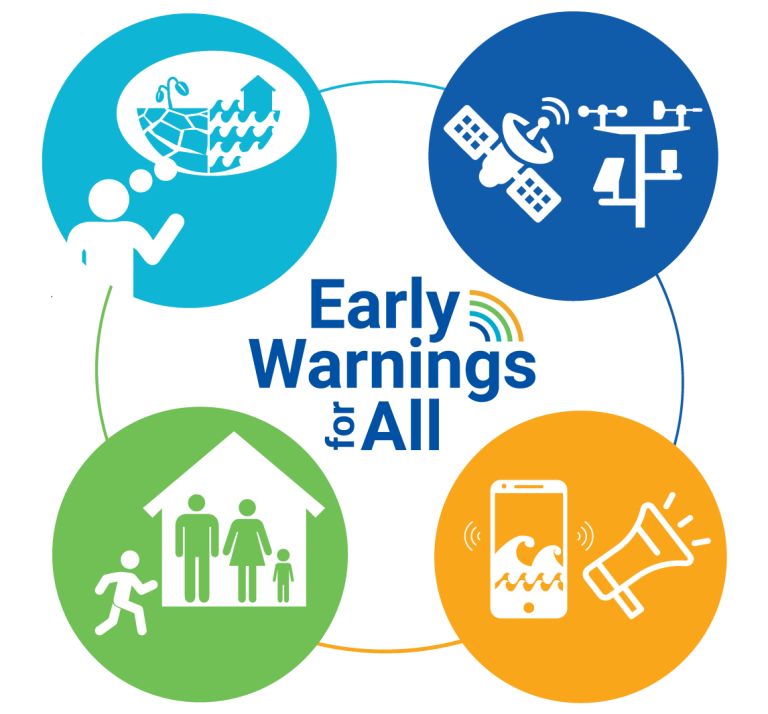
IFRC and Early Warnings for All (EW4All) Initiative
Launched in 2022, Early Warnings for All (EW4All) the UN, governments, civil society and partners to ensure universal protection through people‑centered, multi‑hazard early warning systems.
IFRC is the global lead for Pillar 4 – Preparedness to respond to warnings, working to ensure that communities and local governments have the knowledge, capacity, and resources to act when warnings arrive. In addition, IFRC actively contributes to Pillar 1: Disaster Risk Knowledge and Pillar 3: Warning Dissemination and Communication — helping ensure that community-level risk assessments feed into national systems and that warnings are delivered through trusted, accessible channels.
Tools and resources overview
A wide range of digital and analogue tools, methodologies, and guidance materials have been developed within the RCRC Network to support early warning and anticipatory action. Most tools and resources in this compendium fall into these four categories — see the resource type description below to learn more.
A wide range of digital and analogue tools, methodologies, and guidance materials have been developed within the RCRC Network to support early warning and anticipatory action. Most tools and resources in this compendium fall into these four categories — see the resource type description below to learn more.
Four Pillars of effective EWS
The following sections present tools and resources organized around the four pillars of early warning systems. Click on each title to learn more and see how each resource supports different aspects of EWS.
Disaster Risk Knowledge
Collecting data and undertaking risk assessments to increase knowledge on hazards and vulnerabilities and trends.
Relevant RCRC tools and resources:
Detection, observations, monitoring, analysis and forecasting of hazards
Developing hazard monitoring and early warning services.
Relevant RCRC tools and resources:

Warning dissemination and communication
Communicating risk information to all those who need it.
Relevant RCRC tools and resources:

Preparedness to respond to warnings
Ensuring communities and governments have the knowledge and means to act on early warnings.
Relevant RCRC tools and resources:
Cross-cutting
Foundational elements that support and strengthen all four pillars of an EWS
Community Engagement and Accountability
Ensuring EWS are rooted in local participation, empowering communities to co-create solutions that reduce vulnerability and improve response capacities
Relevant RCRC tools and resources:
Effective Governance and Institutional Arrangements
Establishing legal, policy, and coordination frameworks to enable effective EWS from national to local levels.
Relevant RCRC tools and resources:
Tools and resources directory
Browse the cards below to see all the resources. The pillar icons show where each tool fits in EWS and which pillars it supports, and the tag at the top shows the tool type. Click Learn More for a brief overview and guidance on how the tool can be applied across EWS pillars.
While most resources are for direct use by National Societies, the compendium also includes tools meant to be implemented by other actors (e.g., governments), where the RCRC plays a key role through advocacy, technical support, and coordination.
Methodology
Enhanced Vulnerability and Capacity Assessment (EVCA)
A participatory approach that helps communities map risks, identify capacities, and plan actions for resilience.
Overview
The Enhanced Vulnerability and Capacity Assessment (EVCA) is a long-standing standardized methodology for community risk mapping. EVCAs guide volunteers to gather data on hazards, vulnerabilities and capacities, producing risk profiles and maps. These serve as the “foundation” for community-based DRR, including community EWS, and response capacity planning.
To complement EVCA, the Communication Landscape Analysis Tool for EWS was developed. This tool can be used alongside the EVCA process to better understand a community’s information ecosystem to improve dissemination of alerts. For more details, please refer to the Warning Dissemination tab under Use Across EWS below.
Use Across EWS
Methodology
Climate Risk Assessment (CRA)
Structured process to assess current and future climate risks at national and sub-national levels.
Overview
The National Climate Risk Assessment (CRA) is the first step of the IFRC Climate Action Journey — an integrated approach to scaling up climate action and advancing locally led adaptation. It provides National Societies with a structured process to analyze climate hazards, vulnerabilities, and exposure, offering a comprehensive overview of historical, current, and projected climate risks and their humanitarian implications and sectoral impacts at national and sub-national levels.
The CRA establishes the evidence base for all the consecutive Climate Action Journey work and can be used for any broader programming to integrate climate risks, helping position National Societies as trusted partners in national and community climate and resilience action.
Use Across EWS
Digital Tool
Global Risk Watch – IFRC GO
A risk data analysis tool to understand estimated hazard impacts and exposure.
Overview
The Risk Watch tool, hosted on the IFRC GO platform, provides information on the modeled impact of forecasted or detected natural hazards (e.g., floods, storms, droughts, wildfires, earthquakes) globally. It helps predict the number of people exposed to imminent and seasonal hazards and assesses each country's overall risk for specific hazards.
Risk Watch visualizes curated disaster risk data to support decision-making and improve situational awareness during crises. It draws on open-source data from IFRC, National Societies, and partners, including governments, academia, UN agencies, the private sector, and other international organizations. The tool informs operational planning and response by providing potential impact estimates for forecasted events. It also enables risk comparisons between countries throughout the year to guide resource allocation for disaster risk reduction (DRR), anticipatory action, and climate adaptation.
Use Across EWS
Guidance / Manual
Collaborating with national climate and weather agencies: a guide to getting started
Guidance for strengthening collaboration between RCRC actors and meteorological services to co-produce forecasts.
Overview
This guidance document provides practical recommendations for strengthening collaboration between Red Cross Red Crescent actors and National Meteorological and Hydrological Services (NMHSs). It outlines approaches for co-producing forecasts, building institutional partnerships, improving forecast relevance for humanitarian action, and ensuring that scientific forecasts are better linked to preparedness and early action efforts.
Use Across EWS
Digital Tool
Impact Based Forecasting Portal (IBF Portal)
A digital decision-support platform that combines hazard forecasts with exposure and vulnerability data to predict likely impacts and trigger early actions.
Overview
The Impact-Based Forecasting Portal is a decision-support platform that helps disaster managers prepare for and respond to hazards before they strike. It combines weather and hydrological forecasts with local data on population and infrastructure to show not just what hazard is coming, but who will be affected, where, and when. The portal answers four critical questions for anticipatory action: When should we act? Where will the impact be greatest? Which areas should we prioritize? And what level of action is needed?
By providing impact estimates at sub-national level (down to district or municipality), the IBF portal enables National Societies and their government partners to target early actions where they matter most. Users can set customized alert thresholds — low, medium, and high — for multiple hazards, allowing graduated responses that match the severity of forecasted events rather than relying on single activation triggers.
Use Across EWS
Guidance & Key Messages
Public Awareness and Public Education (PAPE) for DRR
Actionable safety messages that support preparedness efforts and help act on early warnings.
Overview
Public awareness and education are essential components of disaster risk reduction and EWS, helping individuals and communities understand hazards, recognize warning signals, and take protective actions. They cover a broad range of activities — from campaigns and school programs to community outreach — that strengthen preparedness and support early action.
Within this wider effort, Public Awareness and Public Education (PAPE) key messages and accompanying guide provide standardized, action-oriented guidance for many hazards. Developed by IFRC and Save the Children with input from global experts, PAPE offers clear, evidence-based content that can be adapted by National Societies and partners to local contexts. These messages promote consistent safety practices, inform awareness campaigns, and serve as a foundation for alerts and early warning communications.
The IFRC network has a long history in helping frame relevant warning messages for different audiences, using the PAPE messages on what protective actions to take, and strengthening the link between community and national EWS. National RCRC Societies can further localize PAPE messages in collaboration with governments, academia, civil society, and other partners, ensuring relevance, trust, and wide adoption.
Use Across EWS
Digital Tool
WhatNow – IFRC National Society Preparedness Messages Platform
A repository of locally adapted early action messages that help make alerts more actionable.
Overview
Formerly known as the WhatNow platform, the IFRC National Societies Preparedness Messages Platform is a digital repository of PAPE messages. It hosts a curated library of ready-to-use, multi-hazard preparedness and early action messages. These messages are adapted by RCRC National Societies in coordination with government partners and technical experts to ensure local relevance and consistency (see section above). Once adapted and agreed, they are uploaded to the platform by National Societies, providing a centralized and trusted source of actionable guidance.
Being structured in early warning lead times (imminent event, warning (24 - 48h), and anticipated (3 - 5 days) as well as longer time horizons, the messages can support early warning, preparedness and resilience building communications. An API allows government and media partners to access the messages with National Society attribution and distribute them through digital and non-digital communication channels, including through early warning alerts.
Use Across EWS
Digital Tool
IFRC Alert Hub
A free aggregator of official multi-hazard alerts issued worldwide, providing timely and reliable access to warnings.
Overview
The IFRC Alert Hub is a free online platform that aggregates published Common Alerting Protocol (CAP) alerts from official alerting agencies worldwide, providing open access to multi-hazard alerts at national and, where applicable, local levels. The platform centralizes emergency alerts for the use of rebroadcasters such as online media, Google, weather apps, alerting apps and humanitarian actors, helping deliver timely, reliable warnings to at-risk communities.
The IFRC leverages the Alert Hub to integrate hazard alerts into the IFRC data ecosystem to inform situational awareness and operational decision-making. The tool was developed as part of broader IFRC Alert Hub initiative, which promotes CAP adoption and encourages National RCRC to collaborate with national authorities for its implementation.
Use Across EWS
Methodology
Preparedness for Effective Response (PER) Approach
A structured approach to strengthen National Societies' preparedness capacities to ensure timely and effective humanitarian assistance.
Overview
The Preparedness for Effective Response (PER) Approach provides a structured framework to assess and strengthen a National Society’s preparedness and response capacity. At its core is the PER Mechanism, which outlines the key functions, capacities, tools, and processes needed for effective disaster and crisis response. It fosters a shared understanding and language around preparedness across the IFRC network.
Drawing on decades of Red Cross Red Crescent experience, PER helps National Societies comprehensively examine their preparedness and response systems. It aims to empower them to innovate in disaster risk management actions, ultimately strengthening local preparedness capacities and ensuring more effective humanitarian assistance delivery.
The PER Approach aims to:
- Reinforce the role of a NS within national and local emergency management systems.
- Empower NSs to continuously adapt to changing risk landscapes and the needs of affected populations.
- Improve the quality and accountability of disaster preparedness and response, including international support from the IFRC network.
- Contribute to the coordination of the local, national and global systems.
- Continuously learn from preparedness programmes and emergency operations’ experience.
If you are from a National Society and are interested in the PER approach, contact NS.preparedness@ifrc.org
Use Across EWS
Digital Tool
AccessRC
A secure mobile application helping National Societies deliver rapid, accountable, and scalable assistance.
Overview
AccessRC is a Red Cross Red Crescent network platform, supported by the IFRC, that enables secure registration, targeting, communication, and delivery of humanitarian assistance. It is available in 54 languages and is designed to support a wide range of assistance modalities, including cash and voucher assistance (CVA), in-kind distributions, information campaigns, and other forms of support.
In addition to assistance delivery, AccessRC provides the ability to deploy and collect survey information, including needs assessments and post-distribution monitoring, helping National Societies make evidence-based decisions and strengthen accountability to affected people. By providing a centralized, flexible, and secure system, AccessRC helps National Societies scale assistance quickly, ensure data protection, and deliver timely and appropriate support, even as people move within a country or across boarders.
Examples of Use:
- Lithuanian Red Cross – used AccessRC to conduct rapid checks during evacuations.
- Bulgarian Red Cross – used it for distributing food parcels, hygiene kits, and cash assistance.
- Romanian Red Cross – applied it to deliver cash assistance.
- Costa Rica Red Cross – leveraged the platform for information campaigns.
- Peruvian Red Cross – used it for both needs assessments and cash distributions.
Use Across EWS
Guidance
Forecast-based Financing (FbF) Practitioners Manual
A practical guide that helps National Societies design, operationalize, and implement Forecast-based Financing systems and Early Action Protocols.
Overview
Forecast-based Financing (FbF) is currently the primary Red Cross Red Crescent anticipatory action methodology, enabling National Societies to access humanitarian funding for early action based on forecast information combined with risk and impact analysis. When a predetermined trigger threshold is reached, funds are automatically allocated to support rapid implementation of early actions before a disaster strikes. The core instrument for this is the Early Action Protocol (EAP), which clearly sets out when and where to act, what actions will be taken, and who is responsible.
The Forecast-based Financing Practitioners Manual is a comprehensive, step-by-step guide to designing and implementing FbF systems and developing EAPs. It takes users through the full FbF programme cycle — from initial scoping and stakeholder engagement to early action selection, trigger development, activation planning, budgeting, simulations, MEAL, and EAP submission.
Structured as a “journey,” the manual offers clear chapters, toolboxes, and quizzes to support practical application, with extensive operational guidance on setting up programme architecture, preparing activation systems, coordinating decision-making, and ensuring the readiness required to implement anticipatory actions effectively and safely.
Use Across EWS
Funding mechanism
Anticipatory Pillar of the IFRC-DREF
A dedicated funding mechanism that enables Red Cross and Red Crescent Societies to take actions before disasters strike.
Overview
To support the implementation of anticipatory actions, the Anticipatory Pillar of the IFRC DREF enables National Societies to access pre-agreed funding for early actions based on forecast-based triggers. Through Early Action Protocols (EAPs), National Societies develop plans that outline specific actions to be taken once forecast thresholds are reached, aiming to reduce the humanitarian impacts of predictable hazards. Once approved, these protocols allow for the timely release of funds ahead of disasters, supporting early preparedness and protective actions before the onset of an event.
The Anticipatory Pillar of the IFRC-DREF is managed by the IFRC Secretariat as a central fund. Any National Societies can develop an EAP and simplified EAP (sEAP) and apply to access funding from the DREF.
Use Across EWS
Guidance
Pre-Financing Anticipatory Action: Guide for National Societies
Step-by-step guidance for National Societies on designing pre-financing strategies to enable timely anticipatory action.
Overview
The Pre-Financing Anticipatory Action Guide provides practical guidance for National Societies on how to design and implement financial preparedness strategies to secure funds ahead of forecasted hazards. There are a variety of ways National Societies can pre-finance funding for early action and response operations, and this Guide offers step-by-step advice on establishing pre-financing mechanisms that can enable faster, more predictable funding for anticipatory action.
The guide supports finance, logistics, and program teams in identifying funding sources, designing financial triggers, and aligning pre-financing arrangements with operational early action plans.
Use Across EWS
Guidance
Anticipatory Action Simulation Exercise Toolkit and Facilitator Manual
Practical guidance to plan, run, and evaluate simulation exercises that test and strengthen anticipatory action (AA) systems.
Overview
The Anticipatory Action Simulation Exercise Toolkit and Facilitator Manual compile proven practices and provide tools for countries and organizations implementing AA to conduct effective simulations or table-top exercises. SimEx enables practitioners to explore challenges and decisions involved in activating AA before a disaster occurs.
The toolkit covers the full exercise lifecycle — planning, scenario development, implementation, and evaluation — so governments and partners can test approaches, learn from real-time decision-making, and refine implementation modalities. By simulating activation, users can refine protocols, improve coordination, and strengthen AA readiness, including in contexts where a real activation has not yet occurred.
Use Across EWS
Report
Strengthening National Disaster Risk Management Systems through integration of anticipatory action
An IFRC report on how governments can institutionalize anticipatory action, and how humanitarian actors, including RCRC National Societies, can support this process.
Overview
Scaling and sustaining anticipatory action depends on government ownership. The Strengthening National Disaster Risk Management Systems through integration of anticipatory action report explores how anticipatory approaches are being integrated into national disaster risk management systems, drawing on global trends and concrete examples with two deep-dive case studies from Nepal and Madagascar. It highlights emerging examples of government leadership, common barriers to integration, and the roles RCRC National Societies and partners can play in enabling this shift.
The report identifies practical entry points – legal, operational, financial, and forecasting – for embedding anticipatory action into existing systems, and offers actionable recommendations for governments and humanitarian actors.
Use Across EWS
Toolkit
Anticipatory Action Planning Toolkit
A practical source of guidance, technical resources and templates compilation to support implementation of anticipatory action programming.
Overview
The Anticipatory Action Toolkit offers step-by-step guidance, practical tools, case studies, and templates to support the development of anticipatory action frameworks, including Early Action Protocols (EAPs). It outlines key components such as risk analysis, trigger development, early action design, financing mechanisms (including the anticipatory pillar of the IFRC Disaster Response Emergency Fund – DREF), coordination arrangements, and monitoring and learning.
The toolkit promotes a people-centered approach to anticipatory action, emphasizing inclusion, community engagement, and alignment with national disaster risk management systems. It supports National Societies in operationalizing forecast-based and impact-based approaches and strengthening linkages between early warning systems and early action. The resource can be used to guide new anticipatory action initiatives or to strengthen and institutionalize existing efforts within broader disaster risk reduction and climate adaptation strategies.
Use Across EWS
Cross-Cutting
Community Engagement and Accountability
Effective early warning systems (EWS) must be grounded in a people-centered approach that reflects the knowledge, capacities, and priorities of at-risk communities. Rather than treating these groups as passive recipients of information, people-centered systems engage them as co-creators and decision-makers, strengthening their ability to act on early warnings.
Community engagement should be integrated throughout the design, implementation, and evaluation of EWS, including anticipatory and responsive actions that safeguard individuals and the broader community. To ensure inclusivity, accessibility, and actionability, people-centered principles must be embedded across all four pillars of EWS. While many resources listed under each pillar reflect people-centered approaches, those included in this section are featured here because they span across all four pillars. Placing them in this section highlights their cross-cutting role.
Methodology
Community Early Warning Systems (CEWS)
Guidance and materials to design and establish people-centered EWS with direct community participation and ownership.
Overview
Community Early Warning Systems (CEWS) offer a model for designing people-centered EWS through direct participation and engagement of at-risk communities. Developed by or with — not just for — communities, CEWS provide locally led ways to gather and interpret risk information, monitor hazards, and disseminate clear, actionable alerts that reduce disaster risk. Locally led and implemented, CEWS can fill gaps in national systems by providing community-driven solutions rooted in participation and ownership.
As trusted community partners, National Societies can support the establishment of CEWS by equipping at-risk communities with the knowledge, skills, and tools to monitor hazards and take anticipatory action, particularly in remote, underserved, or marginalized areas. Key resources include:
- CEWS Guiding Principles is a Strategic Document that builds a strong foundation and inspires readers to ask the right questions, explore a wider perspective, develop better programming and scale up RCRC initiatives.
- CEWS Training Toolkit is an operational document that contains a Training of Trainers material with ready-to-adapt and run modules and a roster of trainers. It is flexible and adaptable for every new context, using highly participatory methods.
The CEWS Training Toolkit is currently being revised and an updated version will be shared as soon as it is ready.
Use Across EWS
Methodology
Community Trust Index (CTI) for Early Warning Systems
Evidence-based methodology to measure and track community trust in early warnings and the actors who deliver them.
Overview
The Community Trust Index, developed by the IFRC Community Engagement and Accountability (CEA) team, is an evidence-based tool to measure and track the levels of trust that communities have in Red Cross and Red Crescent National Societies and other humanitarian actors. The Index supports efforts to strengthen trust and, in turn, improve the effectiveness of humanitarian programs.
Use Across EWS
Trust in warnings and their source is critical for people to understand, believe, and act on early warnings. The Community Trust Index for Early Warning Systems is a practical tool to assess how much communities trust early warning messages and the actors behind them. It measures both the perceived accuracy (competence) and fairness (values and ethics) of warnings, helping National Societies and partners identify trusted communication channels, messengers, and gaps in system credibility. By integrating community feedback, the Index helps design more effective, people-centered early warning systems that promote timely action and strengthen disaster preparedness.
Effective Governance and Institutional Arrangements
Effective governance plays a critical role in enabling successful early warning systems by establishing the necessary frameworks and structures. Good governance is strongly linked to higher preparedness levels: 95 out of 101 countries reporting multi-hazard early warning systems also have national disaster risk reduction strategies. Countries with more comprehensive strategies typically demonstrate.
As auxiliaries to public authorities, National RCRC Societies can support the strengthening of disaster risk governance and advocate for integrating early warning and anticipatory action into disaster risk management laws, policies, operational plans, and funding mechanisms.
Guidance
The Checklist on Law and Disaster Preparedness and Response
Overview
IFRC Disaster Law is a program of the IFRC which aims to save lives and keep communities safe through more effective disaster laws, policies, and plans. IFRC Disaster Law works with National RCRC Societies and governments to strengthen disaster risk governance through the development and implementation of disaster- and emergency-related instruments. It offers extensive resources on strengthening the governance and legal foundations for disaster risk reduction, preparedness, and response.
More specifically, IFRC’s Checklist on Law and Disaster Preparedness and Response supports governments, National Societies and other stakeholders with technical assistance for the strengthening of legal frameworks relating to disaster preparedness and response, including early warning early action. The Checklist includes support for establishing legal frameworks for an effective multi-hazard early warning system.
Use Across EWS
Early action starts with strong legal frameworks. Mandating early action in laws, policies, and plans helps ensure it happens. Drawing on the Checklist, the Legal frameworks for early warning early action brief explains how these instruments can specify what actions are taken, when they are triggered, who is responsible, and how IFRC Disaster Law can support governments to strengthen legal frameworks for early action.
Guidance
The Checklist & Handbook on Law and Disaster Risk Reduction
Overview
The Checklist on Law and Disaster Risk Reduction is a practical tool for lawmakers, implementers, and partners to assess whether national and local laws enable effective DRR. It looks beyond core disaster risk management (DRM) acts to include sectoral laws and regulations, such as land-use planning, building, environment, and natural-resource management, that shape risk and resilience. The Checklist supports structured legal reviews and helps align national frameworks with international standards, especially the Sendai Framework.
A companion resource, the Handbook on Law and Disaster Risk Reduction, offers step-by-step, practical guidance on how to apply the Checklist in different country contexts. While the approach should be tailored to national needs, the Handbook outlines common process steps, roles, and considerations to strengthen laws, regulations, and institutional arrangements for DRR.
Use Across EWS
Strong legal frameworks are essential for enabling coordinated, inclusive, and timely early warning systems. The Checklist supports governments and partners, including National Societies, in identifying legal gaps and opportunities to strengthen mandates, clarify institutional roles, and ensure early warning systems are backed by enforceable laws and policies.
It includes guidance on legal provisions for early warning procedures, DRR education and awareness-raising, and the inclusion of vulnerable groups, along with other components that are critical to effective early warning and anticipatory action.
Brief
From Alert to Action: Legal and Policy Frameworks for Early Warning Early Action
Overview
From Alert to Action: Legal and Policy Frameworks for Early Warning Early Action distills the core elements of disaster risk governance that enable Early Warning Early Action (EWEA): clear mandates, coordinated SOPs, accessible communication requirements, pre-arranged financing, and accountability to at-risk communities. It explains what needs to be in place in laws, policies, strategies, and plans so roles, triggers, and resources are defined before a hazard strikes, making early action timely, inclusive, and scalable.
Use Across EWS
This brief can inform EWEA work by guiding policymakers, practitioners, and advocates in assessing and strengthening legal and policy frameworks that support timely, coordinated, and inclusive action. It offers practical insights for integrating EWEA into broader disaster risk governance and supports efforts to operationalize the Early Warnings for All initiative at the policy level.
Network of Expertise
The IFRC network features several specialized knowledge hubs, reference centers, and initiatives that advance early warning and anticipatory action. Each offers tools, technical expertise, and evidence-based guidance to strengthen this work globally. Visit their websites to explore resources and learn more the about network's EWAA work.