Women and Gender in Disaster Management

Gender in water, sanitation and hygiene promotion- Guidance note

Gender and diversity-sensitive water, sanitation and hygiene promotion initiatives lead to more equitable, effective and efficient programming for all members of vulnerable communities. This guidance note provides an overview of gender and diversity issues and practicalities to be kept in mind when designing water, sanitation and hygiene promotion programmes. The practical guidance presented here makes this a hands on tool to […]

Gender in water, sanitation and hygiene promotion- Guidance note Read More »
No Longer Silent: Women from Northern Uganda Demand Livelihood and Psychosocial Support

From http://www.witness.org | This video is about the stories of women from the Greater North of Uganda and their call for the Government of Uganda to uphold its commitments under the Peace, Recovery and Development Plan for Northern Uganda and the Juba Peace Agreements. Upholding these commitments will help provide Ugandan woman affected by this conflict with

No Longer Silent: Women from Northern Uganda Demand Livelihood and Psychosocial Support Read More »

An Integrated Approach to Disaster Risk Reduction and Climate Change Adaptation Webinar

RECORDED WEBINAR – Amy Hilleboe of Catholic Relief Services: A practical resource for program planners and managers alike, Toward Resilience is designed around ten principles that highlight the needs of key vulnerable groups such as women, children, and high-risk communities and illustrate how disaster risk reduction and climate change adaptation can be integrated successfully into

An Integrated Approach to Disaster Risk Reduction and Climate Change Adaptation Webinar Read More »

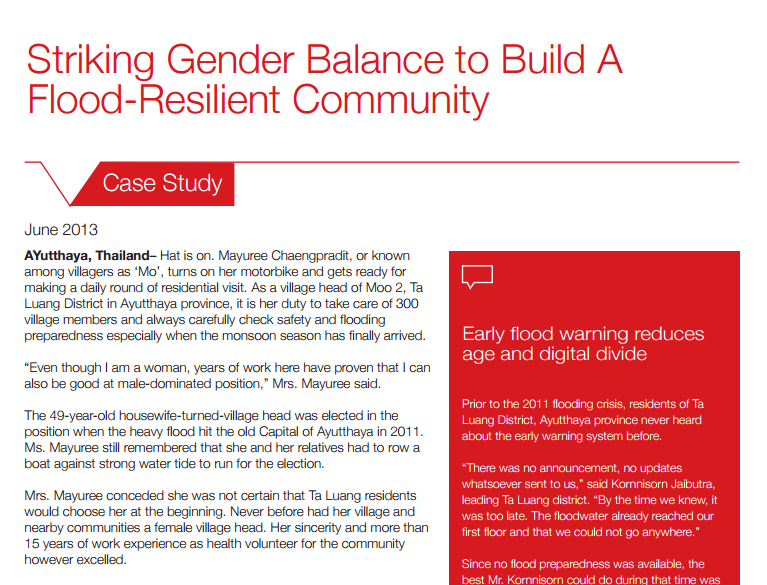
Case Study: Striking Gender Balance to Build A Flood-Resilient Community

    Published June 2013   An estimated US$ 45.7 billion loss caused by the 2011 flooding crisis in Thailand well reflected Mrs. Mayuree’s view towards less-prioritized issue of flooding resilience and preparedness among local communities. To enhance resilience and sustainably reduce vulnerability of flood-prone province, local residents at Ban Ta Luang for the first time learned about disaster risk management skill

Case Study: Striking Gender Balance to Build A Flood-Resilient Community Read More »

Case Study: Getting the word out: Women emergency responders in Bangladesh pass message on, train others

In Bangladesh, histories of oral traditions have laid the foundation for community training in emergency response. A strong colloquial culture in folklore and story telling makes a compelling case why community training is practical and effective. In many cases, knowledge equates to power.   Within these traditions, women have a central role in passing on knowledge to others as provider and educator

Case Study: Getting the word out: Women emergency responders in Bangladesh pass message on, train others Read More »

Mothers’ club in Togo

Following the 5th Panafrican Conference, held in Ouagadougou in September 2000, the Togolese Red Cross decided to rethink its activities in order to maximize impact at the community level, in accordance with the ARCHI 2010 initiative (Health Initiative of the African Red Cross and Red Crescent Societies). The Togolese Red Cross mobilized its volunteers into

Mothers’ club in Togo Read More »

‘Healthy mother, healthy child’ – improving the nutritional and health status of women and children in Kazakhstan

The health of the population of Kazakhstan, in particular of women, requires urgent attention. The nutritional status of women and children, especially those living in economically deprived and environmentally degraded regions of Kazakhstan, is of serious concern. In Semipalatinsk and surrounding areas in east Kazakhstan, used for nuclear tests during the Soviet era, women and

‘Healthy mother, healthy child’ – improving the nutritional and health status of women and children in Kazakhstan Read More »

Scroll to Top