Research

Want to Get Out Alive? Follow the Ants

This article in Nautilus magazine highlights research by Nirajan Shiwakoti at Monash University in Melbourne into the influence of architectural design on evacuation speed and efficiency. Drawing on the observation that panicking humans and ants exhibit strikingly similar crowding and stampeding behavior — including the tendency to converge on a single exit rather than distributing

Want to Get Out Alive? Follow the Ants Read More »
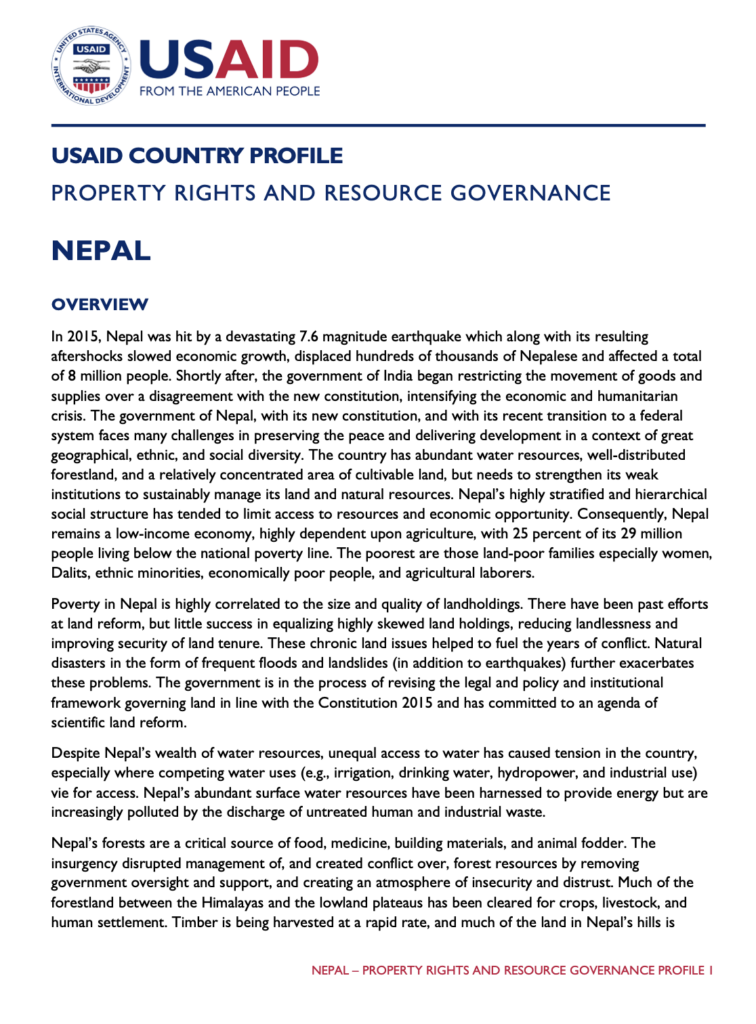
First page of a USAID Country Profile titled 'Property Rights and Resource Governance: Nepal.' The Overview section discusses the 2015 earthquake's impact, Nepal's political transition, land reform challenges, water resource tensions, and forestland pressures affecting the country's poorest populations.

Nepal Land Tenure Profile

This report by USAID looks at the recent state of land use, land distribution, and tenure types in Nepal. The report also explores the processes for securing land rights, community-based land reforms, increasing women’s legal rights related to land and tenure, and managing land disputes and conflicts. (USAID, Sept 2010) Nepal Land Tenure Profile http://usaidlandtenure.net/sites/default/files/country-profiles/full-reports/USAID_Land_Tenure_Nepal_Profile.pdf

Nepal Land Tenure Profile Read More »

Nepal Urban Housing Sector Profile

Based on research by a team of Nepalese and international experts, this report carries out an analysis of five key elements related to urban housing and settlement – land, basic services, housing finance, building materials and construction technologies, and labour. It gives an assessment of how these components are governed by policy, institutional and legal

Nepal Urban Housing Sector Profile Read More »

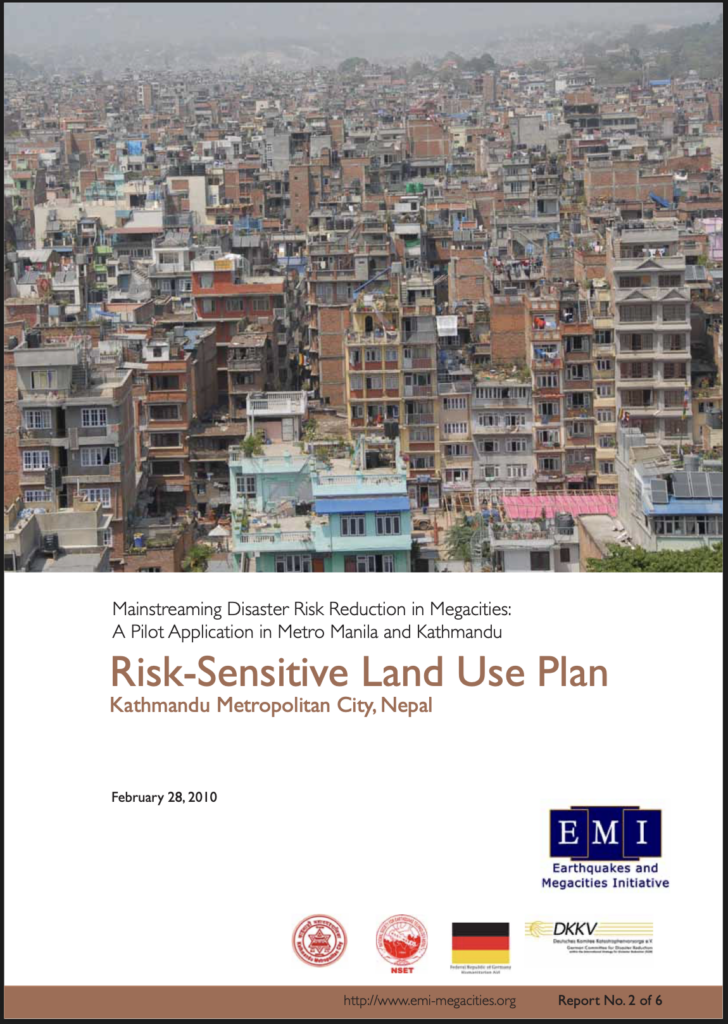
Report cover titled 'Mainstreaming Disaster Risk Reduction in Megacities: A Pilot Application in Metro Manila and Kathmandu — Risk-Sensitive Land Use Plan, Kathmandu Metropolitan City, Nepal,' dated February 28, 2010, Report No. 2 of 6, published by the Earthquakes and Megacities Initiative (EMI) in partnership with NSET, DKKV, and the Federal Republic of Germany. The photo shows a dense aerial view of closely packed multi-story buildings in Kathmandu.

Risk-Sensitive Land Use Plan: Kathmandu Metropolitan City

‘Land use planning has been identified as one of the most effective ways to take the HFA forward. For highly vulnerable cities like Kathmandu, a land use plan offers an opportunity to incorporate risk reduction into development and spatial plans by engaging the government at various levels, private sector, civil society, international development organizations, and

Risk-Sensitive Land Use Plan: Kathmandu Metropolitan City Read More »

Connecting Grassroots to Government for Disaster Management: Workshop Summary

The growing availability and use of social media and other mass collaboration technologies present new opportunities and challenges for disaster management. Platforms now exist that permit collection of data from broad constituencies and rapid communication with endangered communities, but this new interface between the informality of “the crowd” and the formality of policy frameworks raises

Connecting Grassroots to Government for Disaster Management: Workshop Summary Read More »

Disaster risk governance: Unlocking progress and reducing risk

The call and the analysis presented here responds to an identified need for more comparative studies on how governance systems and development situations have shaped progress on disaster risk management (DRM). This paper reviews a selected number of different governance systems in terms of their institutional structures (centralized and decentralized); distribution of power and decision-making

Disaster risk governance: Unlocking progress and reducing risk Read More »

IFRC Disaster Law Working Paper Series cover, Paper No. 3, titled 'Normative Frameworks' Role in Addressing Gender-Based Violence in Disaster Settings,' by Mireille Le-Ngoc, Intern, Disaster Law Programme, dated January 2015.

Normative frameworks’ role in addressing gender-based violence in disaster settings

The problem of gender-based violence (GBV) in emergencies has recently received increased attention worldwide. The Humanitarian Exchange Magazine dedicated a whole issue on GBV in humanitarian crises.The International Committee of the Red Cross demonstrated its concern for sexual violence in armed conflict, launching a Special Appeal to strengthen its response in 2014. In non-conflictual emergency

Normative frameworks’ role in addressing gender-based violence in disaster settings Read More »

Disaster Conflict Interface

The study aims to achieve a comparative analysis of tendencies and experiences that stem from the relationship between disasters and conflict. It also analyses the relative success of existing relevant programming approaches adopted incountry. This comparative analysis aims to: contribute to the body of knowledge on the interactions between disaster and conflict; better understand the

Disaster Conflict Interface Read More »

Community Resilience Performance Measurement

Groupe URD was commissioned by the International Federation of Red Cross and Red Crescent Societies (IFRC) to conduct a consultancy on “Community Resilience Performance Measurement Methodology and Standard Indicators”. The aim of the study was to: To compile, synthesize and highlight some emerging theories, practices and tools in measuring community resilience outside the Red Cross Red Crescent

Community Resilience Performance Measurement Read More »

Scroll to Top