Asia Pacific

The Flood Early Warning Early Action System (FEWEAS)

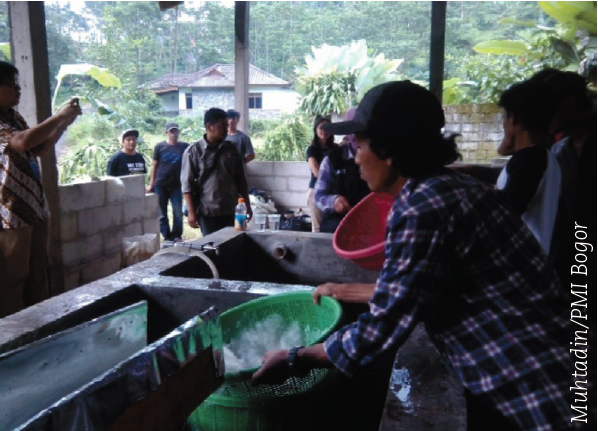
Half of Indonesia’s population of approximately 141 million people lives on the island of Java, home to several river systems as the Citarum river and the Bengawan Solo. Due to changing climate and environmental conditions, these river systems are prone to flooding. The Indonesian Red Cross (Palang Merah Indonesia, PMI), the International Federation of Red […]

The Flood Early Warning Early Action System (FEWEAS) Read More »

The Flood Resilience Alliance – Community Testimonials from Nepal, Mexico and Indonesia

The Flood Resilience Alliance (2013 -2017) is a five-year partnership that set out to develop a model that would deliver effective community flood resilience programmes at scale and contribute to shaping the flood resilience agenda of policy-makers and donors. For the IFRC and National Societies the Flood Resilience Alliance, advocacy and influencing strategies were designed to improve conditions for vulnerable

The Flood Resilience Alliance – Community Testimonials from Nepal, Mexico and Indonesia Read More »

Cox’s Bazar: Migrants are Taking Action as the Rains Fall

  When rain falls in Kutupalong -a temporary home for displaced families in Cox’s Bazar, Bangladesh -it’s not merely an inconvenience. It’s a hazard. Within minutes of a downpour the walkways become slippery mud; the fields turn to puddles; and people’s roofs start to leak. As part of the Bangladesh government’s Cyclone Preparedness Program (CPP), the

Cox’s Bazar: Migrants are Taking Action as the Rains Fall Read More »

Bridging Real-Time Data and Adaptive Management

The case studies show that real-time data systems can, in the right circumstances and with the right enabling conditions, enable adaptive management. In settings where there are no political or institutional constraints to adaptation—and where the timeliness of information is the binding constraint on strategic and operational improvements—real-time data systems can underpin and catalyze data-driven

Bridging Real-Time Data and Adaptive Management Read More »

Flood Early Warning Systems in Nepal: A Gendered Perspective

The Hindu Kush Himalayan region is extremely vulnerable to various types of water-induced disasters, particularly floods and landslides. In Nepal, more than 300 people are killed annually on average as a result of floods and landslides. Inequalities in society are often amplified at the time of disasters, and poor people, especially women, the elderly, and

Flood Early Warning Systems in Nepal: A Gendered Perspective Read More »

Effects of forest fire protection on plant diversity in a tropical deciduous dipterocarp-oak forest, Thailand

 A two-hectare plot of a deciduous dipterocarp-oak forest of Doi Suthep-Pui National park of northern Thailand protected against fire for 28 years was compared with a similar, but frequently burnt forest nearby with respect to changes in plant diversity. The objective of the study was to find out the effects of forest fire protection on

Effects of forest fire protection on plant diversity in a tropical deciduous dipterocarp-oak forest, Thailand Read More »

Reclamation of flood-damaged areas through community based agro-forestry: A case study from Nepal

More than 400,000 ha of land have been damaged by river floods in Nepal. Agro-forestry activities were implemented in those areas with the twin objectives of countering land degradation problems and meeting the demands of local people for fuelwood, fodder, and small timber. This study assessed the effectiveness of such practices in the riverside areas

Reclamation of flood-damaged areas through community based agro-forestry: A case study from Nepal Read More »

Measuring Resilience Capability of Drought-prone Desert Communities: A Case Study of Tharparkar, Pakistan

Abstract The purpose of this paper is to propose a mathematical index to measure the resilient capability of drought-prone desert communities in Tharparkar, Pakistan. The paper analyses the constructs and definitions of the term resilience, describes the concept and practical applications of the integrated programming approach, present key findings of the integrated vulnerability and capacity

Measuring Resilience Capability of Drought-prone Desert Communities: A Case Study of Tharparkar, Pakistan Read More »

Scroll to Top