
shelter

Zaatari: The Instant City

Affordable Housing Institute (AHI) published a report on Al Zaatari Refugee Camp in Mafraq Governate, Jordan. The camp has become the second largest refugee camp in the world and the fourth largest city in Jordan.   Though considered to be a temporary settlement, Zaatari is one of the largest and fastest-growing cities in Jordan, housing more than 120,000 […]

Zaatari: The Instant City Read More »
Shaping your Shelter: A game on post-disaster reconstruction of homes

A participatory activity for communities affected by disasters aimed at inspiring a desire to learn about safe building methods, in particular “bracing” (structural reinforcement). With limited time and materials, players construct shelter for households recently affected by an extreme event. They confront the trade-offs between quick and cheap housing versus stronger but more resource- and

Shaping your Shelter: A game on post-disaster reconstruction of homes Read More »

The Sphere Project Handbook

The Sphere Handbook is designed for planning, implementation, monitoring and evaluation during humanitarian response. It is also an effective advocacy tool when nego­tiating for humanitarian space and for the provision of resources with authorities. Furthermore, it is useful for disaster preparedness activities and contingency planning, with donors increasingly including the standards in their reporting requirements.

The Sphere Project Handbook Read More »

Guiding principles on security of tenure for the urban poor

This Guidelines are published by the Special Rapporteur on Adequate housing in Feb 2014.  I believe that these principles can be useful on our programs, (specially our Recovery  and Urban programming) as it presents an overview on how to strengthen diverse tenure forms, both formal and informal, an overview of mechanisms conducing to security of

Guiding principles on security of tenure for the urban poor Read More »

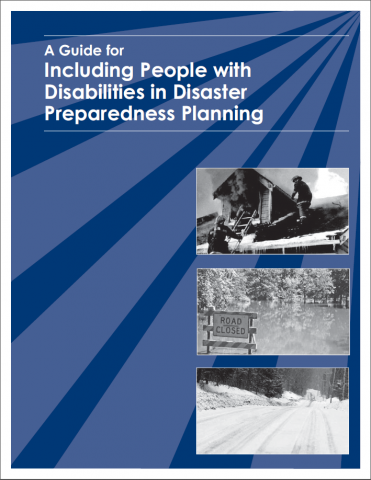
A Guide for Including People with Disabilities in Disaster Preparedness Planning

This guide, written for municipal and regional planners, reflects information,concerns and recommendations that emerged at the daylong forum on December 6, 2005, on “Lessons Learned” from recent large-scale disasters that affected states along the Gulf Coast. This guide is primarily intended to assist people involved in preparedness planning at the municipal and regional levels. It

A Guide for Including People with Disabilities in Disaster Preparedness Planning Read More »

Lessons Learned from Cyclone Phailin: Early Warning, Mass Evacuation, and Multi-Agency Coordination in India’s Disaster Response

This radio discussion, broadcast on All India Radio’s FM Gold channel as part of the program News Analysis, examines the lessons learned from India’s response to Cyclone Phailin — one of the strongest cyclones to strike the country in 14 years. The conversation features Major General V.K. Datta, Senior Specialist at India’s National Disaster Management

Lessons Learned from Cyclone Phailin: Early Warning, Mass Evacuation, and Multi-Agency Coordination in India’s Disaster Response Read More »

Haiti Recovery Operation Summary of the Plan of Action – July 2011 – December 2012

Revised Plan of Action Summary that clearly articulates IFRC secretariat actions moving forward as of July 2011. It continues to use a ‘pillar’ approach but the structure has been simplified to minimize overlap and duplication found in the three-pillar configuration of the 2010 Plan of Action. It also reflects a minimized role for IFRC in HRC core services

Haiti Recovery Operation Summary of the Plan of Action – July 2011 – December 2012 Read More »

Green Recovery & Reconstruction: Training Toolkit for Humanitarian Aid

The Green Recovery and Reconstruction Toolkit (GRRT) is a training program designed to increase awareness and knowledge of environmentally sustainable disaster response approaches.  The GRRT is made of ten modules which are designed to be delivered in a one-day training workshop.  Each GRRT module package includes a trainer’s guide; training materials for a workshop; PowerPoint

Green Recovery & Reconstruction: Training Toolkit for Humanitarian Aid Read More »

Surviving Alone: Improving Assistance to Colombia’s Flood Victims

This Refugees International report highlits shortcomings in the Colombian governtment’s and international agencies’ reponse to the 2010-2011 floods in order to ensure Colombia is better prepared for future flood events. While Colombia has committed to a disaster management framework, the severity of the emergency highlighted gaps in the system including the notable lack of local

Surviving Alone: Improving Assistance to Colombia’s Flood Victims Read More »

Scroll to Top