Americas

Preparedness in America: Research Insights to Increase Individual, Organizational, and Community Action

Advances our understanding of the complexities of motivating the public to prepare by examining trend data on personal preparedness behaviors and by providing findings on several new areas of analysis: Exploring the relationship between preparedness behaviors and individuals’ beliefs and experiences around disasters; Identifying profiles of the general public to assist practitioners in conducting more […]

Preparedness in America: Research Insights to Increase Individual, Organizational, and Community Action Read More »

Awareness to Action

On June 27–28, 2012, the Federal Emergency Management Agency (FEMA) and the American Red Cross (Red Cross) hosted a workshop to discuss how to improve preparedness messaging to encourage the public to prepare themselves and their families for a disaster. According to a series of surveys conducted by FEMA, the public today is little more

Awareness to Action Read More »

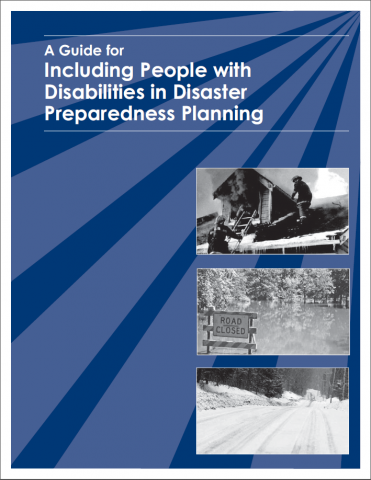
A Guide for Including People with Disabilities in Disaster Preparedness Planning

This guide, written for municipal and regional planners, reflects information,concerns and recommendations that emerged at the daylong forum on December 6, 2005, on “Lessons Learned” from recent large-scale disasters that affected states along the Gulf Coast. This guide is primarily intended to assist people involved in preparedness planning at the municipal and regional levels. It

A Guide for Including People with Disabilities in Disaster Preparedness Planning Read More »

Urban risk assessments : understanding disaster and climate risk in cities

Urban Risk Assessments: Understanding Disaster and Climate Risk in Cities (World Bank, 2012) provides a practical framework for analyzing and managing disaster and climate risks in urban areas. Designed for city officials, urban planners, and development practitioners, the resource introduces the Urban Risk Assessment (URA) methodology, which integrates three core pillars—hazard impact, institutional capacity, and

Urban risk assessments : understanding disaster and climate risk in cities Read More »

Managing Spontaneous Volunteers in Times of Disaster: The Synergy of Structure and Good Intentions

In 2002-03 UPS, the Points of Light Foundation & Volunteer Center National Network, FEMA and the National Voluntary Organizations Active in Disaster (NVOAD) coalition convened a set of partner organizations to review the challenges and opportunities associated with disaster volunteering; develop preliminary recommendations and action steps for addressing the challenges of spontaneous volunteers; and secure commitment from participating organizations to

Managing Spontaneous Volunteers in Times of Disaster: The Synergy of Structure and Good Intentions Read More »

Adaptive Disaster Risk Reduction. Enhancing Methods and Tools of Disaster Risk Reduction in the light of Climate Change

This research report, published by the German Committee for Disaster Reduction (DKKV) and authored by researchers from the United Nations University Institute for Environment and Human Security (UNU-EHS), examines how existing methods and tools of Disaster Risk Reduction (DRR) can be enhanced and adapted to better address the growing challenges of Climate Change Adaptation (CCA).

Adaptive Disaster Risk Reduction. Enhancing Methods and Tools of Disaster Risk Reduction in the light of Climate Change Read More »

Earthquake Property Protection: Practical How-To Guides for Securing Buildings, Equipment, and Utilities (FEMA)

This collection of practical guidance flyers, published by the U.S. Federal Emergency Management Agency (FEMA), provides step-by-step instructions for homeowners, building managers, and facility staff on how to protect property and reduce earthquake-related damage through structural and non-structural mitigation measures. The series covers a wide range of actions that can be taken before an earthquake

Earthquake Property Protection: Practical How-To Guides for Securing Buildings, Equipment, and Utilities (FEMA) Read More »

Drought Preparedness Planning: Building Institutional Capacity

Past attempts to manage drought and its impacts through a reactive, crisis management approach have been ineffective, poorly coordinated, and untimely.  Because of the ineffectiveness of this approach, greater interest has evolved in recent years in the adoption of a more proactive risk-based management approach in some countries. The 10-step drought planning process developed by Wilhite (1991) was

Drought Preparedness Planning: Building Institutional Capacity Read More »

Urban Drought Guidebook: 2008 Updated Edition

Managing water shortages involves using programs to temporarily reduce demand and find alternate water to temporarily increase supply. The guidebook discusses water shortage management programs that belong in water shortage contingency plans. It was first written in 1988, and then updated in 1991 and 2008 to help water suppliers cope with potentially severe drought and other water shortages. The

Urban Drought Guidebook: 2008 Updated Edition Read More »

Scroll to Top