Americas

Case study 9 – “Practice-based learning” to create resilient communities in Nicaragua

The advance of the agricultural frontier and inadequate agricultural practices have contributed to environmental degradation in the sub-watersheds of the Tapacalí and Inalí rivers in the department de Madriz, Nicaragua. Meanwhile, a lack of knowledge and environmental awareness increases the communities’ vulnerability to socio-natural threats. Addressing that vulnerability through an innovative approach that integrates disaster risk

Case study 9 – “Practice-based learning” to create resilient communities in Nicaragua Read More »
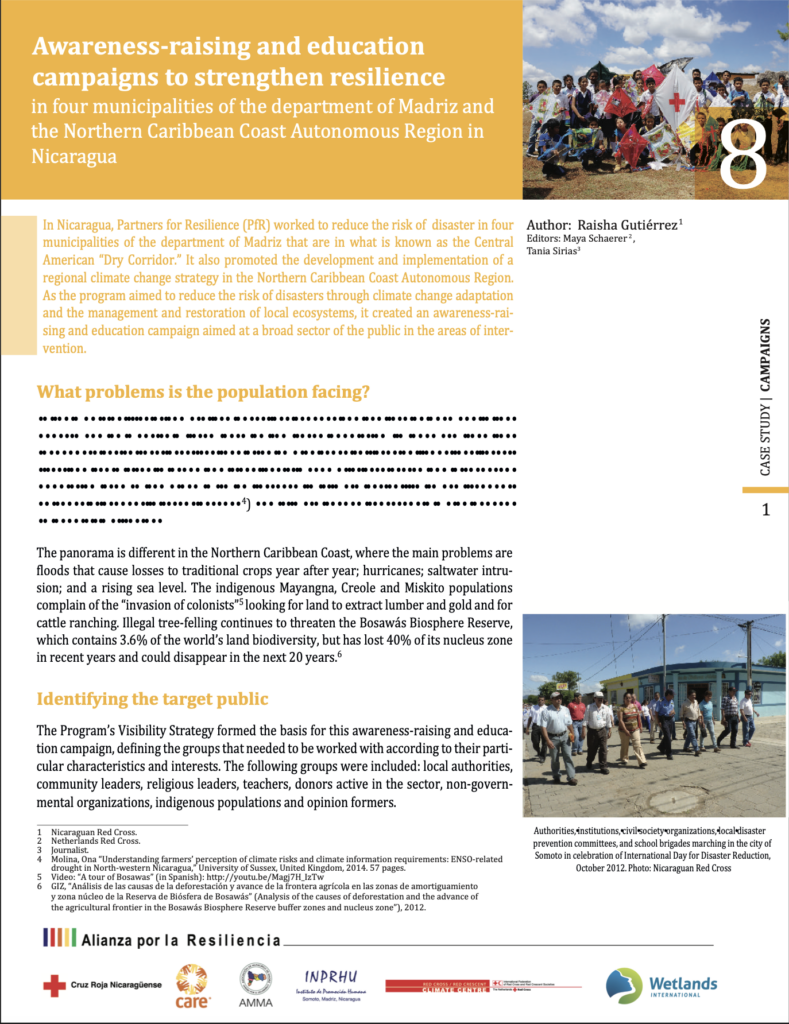
Case study titled 'Awareness-raising and education campaigns to strengthen resilience in four municipalities of the department of Madriz and the Northern Caribbean Coast Autonomous Region in Nicaragua,' by author Raisha Gutiérrez with editors Maya Schaerer and Tania Sirias, published as part of the Alianza por la Resiliencia (Partners for Resilience) series. The top photo shows a group of children and adults gathered outdoors holding colorful kites and a Red Cross banner, and a bottom photo shows a group of authorities and community members marching through a street in Somoto during International Day for Disaster Reduction, October 2012.

Case study 8 – Awareness-raising and education campaigns to strengthen resilience in four municipalities of the department of Madriz and the Northern Caribbean Coast Autonomous Region in Nicaragua

In Nicaragua, Partners for Resilience (PfR) worked to reduce the risk of disaster in four municipalities of the department of Madriz that are in what is known as the Central American “Dry Corridor.” It also promoted the development and implementation of a regional climate change strategy in the Northern Caribbean Coast Autonomous Region. As the

Case study 8 – Awareness-raising and education campaigns to strengthen resilience in four municipalities of the department of Madriz and the Northern Caribbean Coast Autonomous Region in Nicaragua Read More »

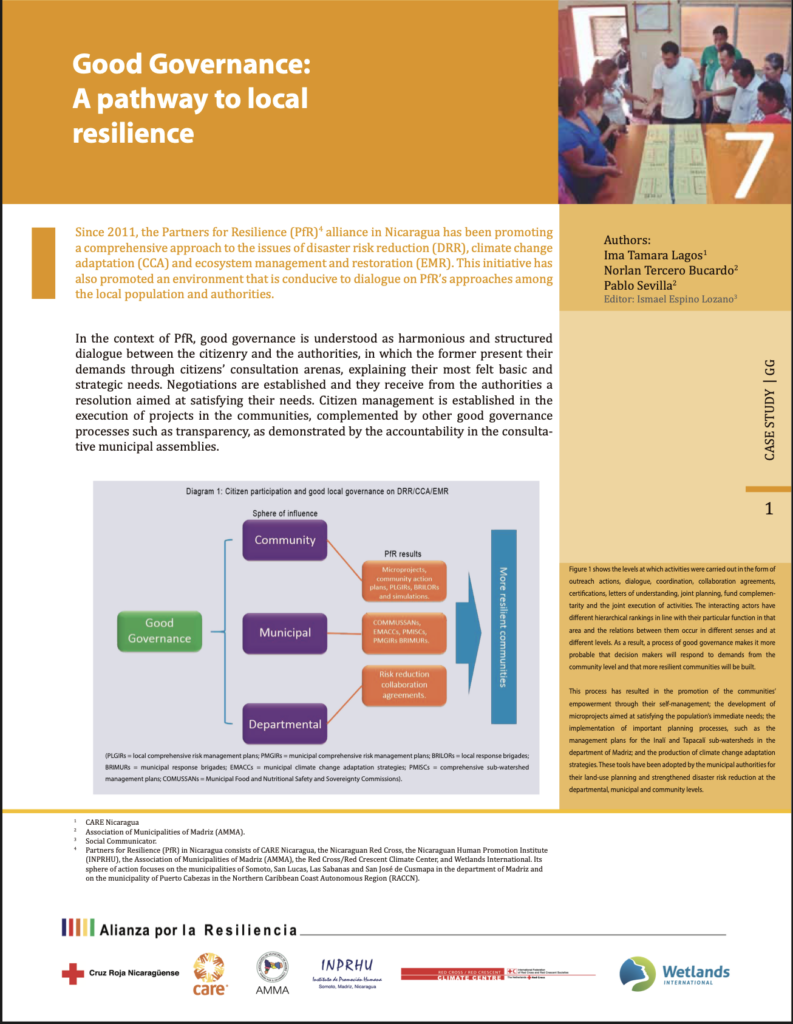
Case study titled 'Good Governance: A Pathway to Local Resilience,' by authors Ima Tamara Lagos, Norlan Tercero Bucardo, and Pablo Sevilla, edited by Ismael Espino Lozano, published as part of the Alianza por la Resiliencia (Partners for Resilience) series. The page includes a diagram illustrating citizen participation and good local governance across community, municipal, and departmental levels, plus a photo of community members reviewing documents together at a table.

Case study 7 – Good Governance: A pathway to local resilience

Since 2011, the Partners for Resilience (PfR) alliance in Nicaragua has been promoting a comprehensive approach to the issues of disaster risk reduction (DRR), climate change adaptation (CCA) and ecosystem management and restoration (EMR). This initiative has also promoted an environment that is conducive to dialogue on PfR’s approaches among the local population and authorities.

Case study 7 – Good Governance: A pathway to local resilience Read More »

Case study 4 – Harmonizing indigenous and local knowledge: “The path towards community and institutional resilience”

“We, the indigenous peoples, do not reject adapting to climate change because we have always, as a people–consulted Nature. We read its signs and foresee; we understand; we harmonize with it which is how we have always lived and survived through the ages, because we are blessed by our actions.” Pablo Ramón Vanegas, member of

Case study 4 – Harmonizing indigenous and local knowledge: “The path towards community and institutional resilience” Read More »

Case study 5 – Strengthening Value Chain Committee’s capacities in the municipality of Somoto: Partners for Resilience’s experience in Nicaragua

For centuries, the ovens in Somoto, in the department of Madriz, Nicaragua, have been baking the distinctive handmade rosquillas (ring-shaped pastry), prepared by hardworking women. These women still preserve the artisan traditions in their 137 shops where they continue preparing the delicious Somoteñan rosquillas, which many consider unique in the world, to such an extent

Case study 5 – Strengthening Value Chain Committee’s capacities in the municipality of Somoto: Partners for Resilience’s experience in Nicaragua Read More »

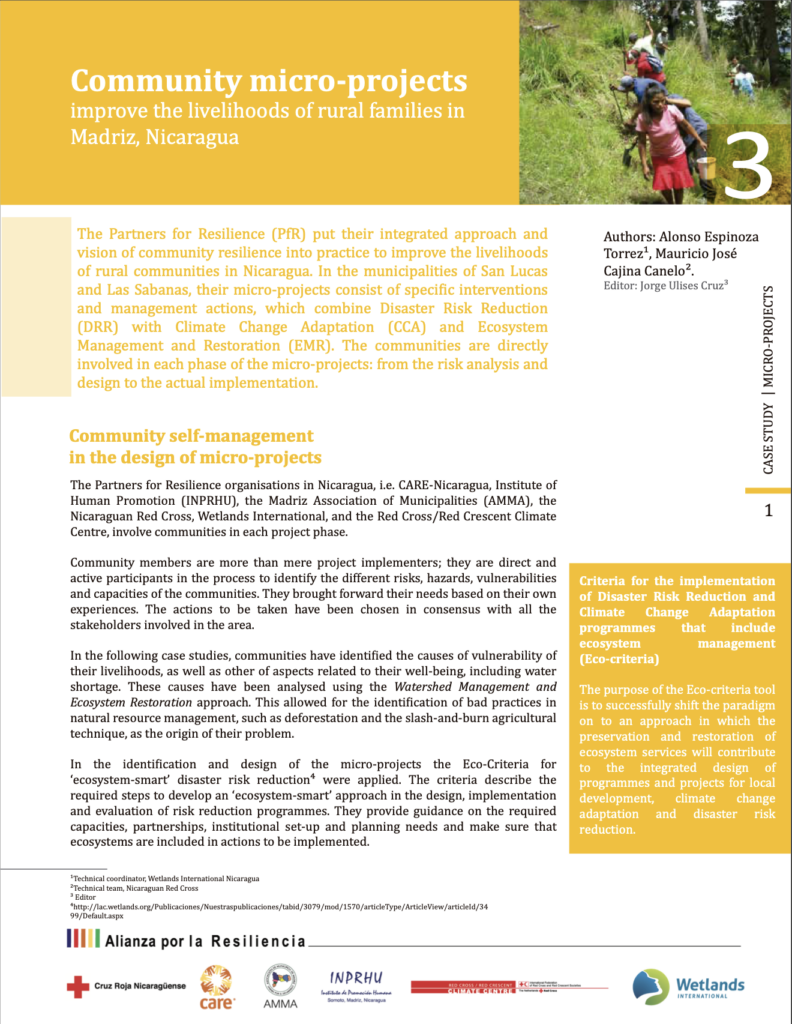
Case study titled 'Community Micro-projects Improve the Livelihoods of Rural Families in Madriz, Nicaragua,' by authors Alonso Espinoza Torrez and Mauricio José Cajina Canelo, edited by Jorge Ulises Cruz, published as part of the Alianza por la Resiliencia (Partners for Resilience) series. The page includes a highlighted box on Eco-criteria for ecosystem-smart disaster risk reduction, and a photo of people walking single-file up a grassy hillside carrying tools and supplies.

Case study 3 – Community micro-projects improve the livelihoods of rural families in Madriz, Nicaragua

The Partners for Resilience (PfR) put their integrated approach and vision of community resilience into practice to improve the livelihoods of rural communities in Nicaragua. In the municipalities of San Lucas and Las Sabanas, their micro-projects consist of specific interventions and management actions, which combine Disaster Risk Reduction (DRR) with Climate Change Adaptation (CCA) and

Case study 3 – Community micro-projects improve the livelihoods of rural families in Madriz, Nicaragua Read More »

La Ruta del Reto

“La Ruta del Reto” es un juego cuyo objetivo es generar actitudes adecuadas para enfrentar los riesgos de desastres aumentados por el cambio climático, la degradación ambiental y otras amenazas que reducen el bienestar de las comunidades. Busca generar respuestas asertivas, a partir de los conocimientos adquiridos previamente por los participantes, frente a los diversos

La Ruta del Reto Read More »

Scroll to Top